Labor Day & the Political Poem

83º ~ feels like 89º, dew point 74º, the swelter-weather returns, bubbling up to heat indices nearing the century mark later this week, no real rain, watering for the second weekend in a row, hummingbirds abound

This morning, the first thing I read was a Philip Levine poem, “Coming Close, the daily poem from The Academy of American Poets. I went on to read another Levine poem, “What Work Is,” archived by the Poetry Foundation. Both of these poems present the complicated lives of working-class people. Among Levine’s other poems there are more direct implications of what happens when one moves from the working class to the middle class, as I have done.

This set me off in writing a really cliched, too overt “political poem,” about my relationship to work. I mean, the draft is really terrible.

But, it got me thinking, how do political poets, and I count Levine as such, poets who comment directly on the conditions of the people with whom they are concerned, how do they do it? How do they honor their subject and make art of it? How do they avoid sentimentality? How do they avoid exploiting the very people they seek to honor? How do they move me without driving me away with points too blunt and too sharp?

If anyone has any answers, I’m all ears.

~~~~~

In the meantime, I must engage in that domestic labor that is grocery shopping and laundry and catching up on bill paying on this glorious holiday that not everyone gets to enjoy. Many folks, especially in retail and food service will be hard at labor today. May they prosper.

Posted by Sandy Longhorn
What I’m Reading: The Book of Scented Things

What I’m Reading: The Book of Scented Things

80º ~ feels like 80º, headed up to 95º, our saving grace…a drop in humidity, no rain and no relief in sight, summer arrives late this year, but it arrives, cicadas and hummingbirds abound

In February 2013, I was invited by Jehanne Dubrow to participate in an anthology project that she was then editing with Lindsay Lusby: The Book of Scented Things: 100 Contemporary Poems about Perfume. Now, the book is done and in the hands of reviewers and contributors. Published by The Literary House Press, it appears the book will become available for sale after its October 7, 2014 debut party at the Rose O’Neill Literary House at Washington College.

You can read about my drafting process here. My perfume was Oranges and Lemons Say the Bells of St. Clement’s by Heeley.

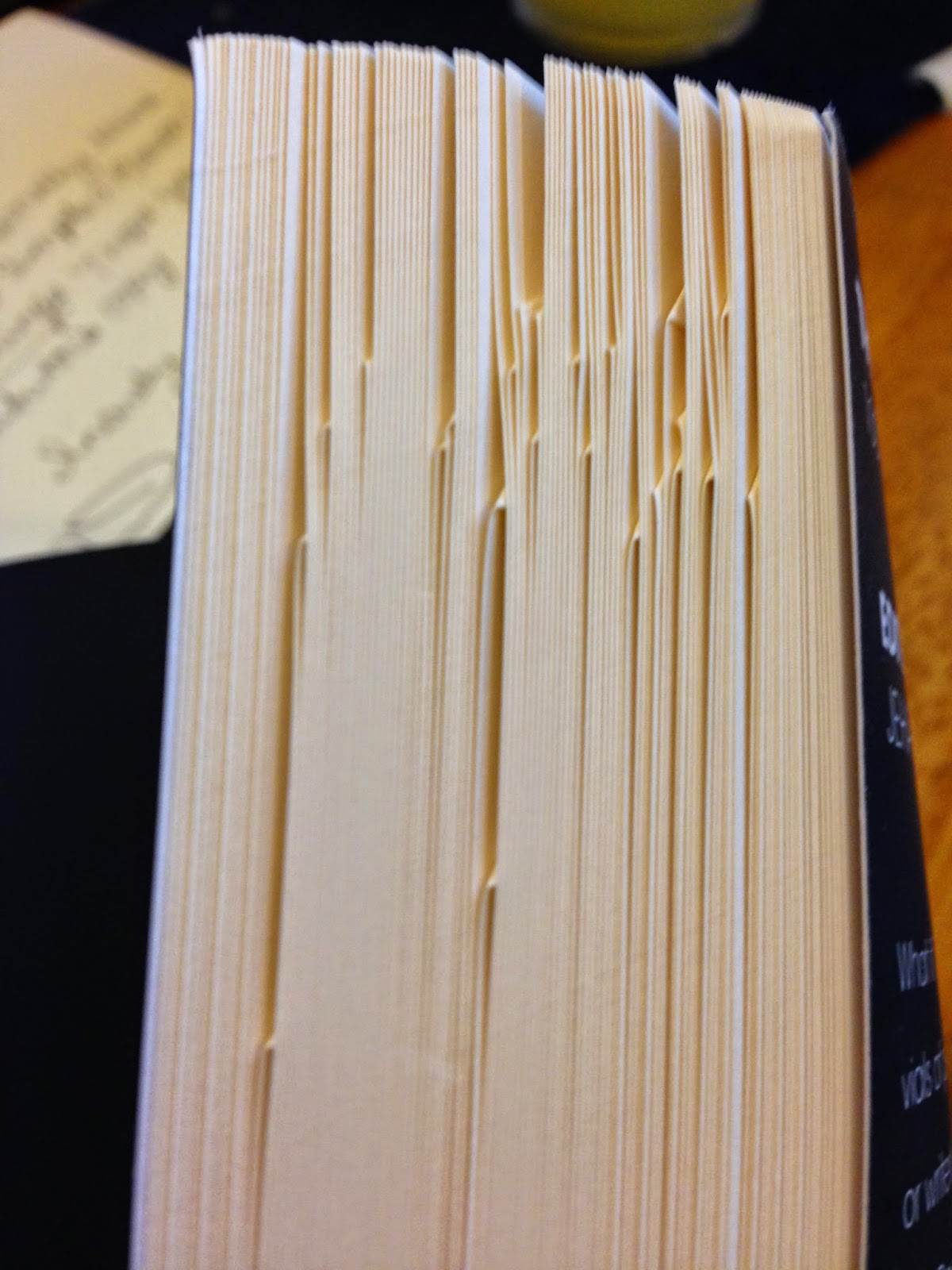
And to whet your appetite, dear reader, here is a glimpse between the covers of the book.

Anthologies, for me, are hit or miss. I tend to read them piecemeal, often only really reading a small percentage of the poems or authors. I mostly associate anthologies with classes, but I know that there are many other readers out there who have distinctly different approaches to anthologies. I tell you all of this as background to this fact: I read The Book of Scented Things cover to cover, devouring each and every poem, and not just because I’m a contributor.

Perhaps the organization of the book compelled me to read linearly. Like most anthologies, the book begins with an introduction (by Jehanne Dubrow), and there is a preface (by Alyssa Harad, author of a book and many articles about perfume). Then, we get to the poems. Each poem is numbered, and numbered in a certain typography that echoes perfume lingo, a la Chanel Nº 5. While some poets chose to mention their perfumes in titles or within the poems, in the contributor notes, the editors have included which perfumes was paired with each poet. While I’m not a perfume wearer, I found myself flipping back there out of curiosity time and time again.

Poem Nº 1 is by Amit Majmudar, and is an anti-assignment poem. The title, “On His Reluctance to Contribute to The Book of Scented Things,” explains. So, we begin with a poem where the first line, “All attars are unutterable,” calls out the challenge for the poets, each assigned a different perfume as inspiration. There were no other “rules” for our writing. We were to write any poem at all, as long as it was in response to the perfume.

I was struck, at first, by the number of poems that directly mentioned the assignment, perhaps by alluding to getting the perfume in the mail or by describing the tiny glass bottle with the black top. It didn’t even dawn on me when drafting “Too Simple a Reason,” my contribution, to start there. Others worked from the idea of the scent on the body, as I did. And still others wrote poems less directly connected to the literal perfume on the body, but as reaction to the fragrance alone. Fascinating.

Another fascination for me is the range of style in the book: short lyrics, longer narrative, single long stanzas, couplets, a sonnet or two, a prose poem, etc. Along this line came the realization that while I recognized many a poet in the book, I met many new writers as well, and now I have a whole new list of books to explore (one of the greatest benefits of anthology reading).

It is nearly impossible to pick a representative poem to quote here, and certainly impossible to pick a favorite as my picture of the dog-eared pages should attest.

However, I’ll list some titles as precursor to your reading the real thing come October, should you choose.

The Lost Bottle (Rachel Hadas)
Sniff (Catherine Wing)
You think language is silly until it happens to you (Dorothea Lasky)
The Perfumier on the Comeback of the Scented Glove (Rebecca Morgan Frank)
Mystery Joins Things Together (Rick Barot)
Gulf City Dialect (Nicky Beer)
This is What Manhattan Smells Like? (Matthew Thorburn)
If Scent is the Trigger of Memory, This is what America Remembers (Nick Lantz)
Too pretty for words (Jessica Piazza)
American Masculinity (Jericho Brown)
Dear Rotten Garden– (Mark Bibbins)
In Algebra Class, Prince Stuck in My Head (Adrian Matejka)
Unrequited Sublime in Three Notes (Traci Brimhall)
At a Certain Point in Marriage (Idra Novey)

Finally, the last poem, Nº 100, is “Your Scent Does Not Remind Me…” by Elana Bell, and we come back full circle to the ideas introduced in Majmudar’s poem. How do we say in words what is evoked by a scent? In between these two poems, there were many references to bodies, relationships, flora and fauna of all kinds, pastorals and urban landscapes, flights of fantasy and crushing confessional poems. It was a wild and wonderful ride.

Many thanks to Jehanne Dubrow and Lindsay Lusby for the great job editing the book. The crew at The Literary House Press did a fabulous job on the production of the book as well. I’m so happy to have been included, and I look forward to hearing what other readers think of the collection once it is available to them.

Posted by Sandy Longhorn
So, Yeah, I Wrote a New Draft Today

So, Yeah, I Wrote a New Draft Today

81º ~ headed up to near 100º today, been swampy for the past four days, hummingbirds zoom the feeders

As many of you know, I believe in the BIC method of writing, where BIC = Butt In Chair. Today marks the beginning of week two for the teaching semester, and my schedule this time around allows me to be at the desk from 7 a.m. – 9 a.m. Monday, Wednesday, and Friday.

Last week, I spent my three BIC sessions mostly reading, and I’ll post about some of that reading soon. On Friday, I also dabbled in the journal, just playing with word gathering (making lists of nouns, verbs, and adjectives from whatever I was reading at the time), and then making some attempt at a few lines.

Today, I re-read the drafts I created in June and got a few inklings of where I might begin. One of the drafts from June is a simple “I am” poem based on whatever was going through my head on that day. Today, I started there again.

Am mirror to the wilted sky.
Am steam risen after rain
hovering groundward.

I got about a dozen solid lines out of the exercise. And the lines feel like a whole draft rather than a series of jagged fragments that go nowhere specific. While this might not become a fully fledged poem, I have begun, again, to focus on language and the line. I know that by following the BIC rule, I’ll eventually figure out what it is I have to say.

What I’m really dying to know is this. What will be my next obsession? Do I need an obsession? Can I just write a bunch of unrelated poems? Has the sickly speaker ruined me by making me dependent on a narrative at work in multiple poems? Should I return to the angry sisters or have I gotten all I can get out of them? Should I write straight-up confessional poems? Should I stick with persona? Do I have the ability to write poems about ideas rather than people and things? Do I have the ability to get pointedly political?

And so, I return to beginner’s mind, again and again and again.

~~~~~

In other creative news, I’ve opened a Square Marketplace to sell both my books and my collages online. You’ll see the bright green “Order Online” button to the right. If you click on it, you will find a way to buy my books online, and you’ll also find my collages there (yeep!).

Posted by Sandy Longhorn

What I’m Reading: Flight of August by Lawrence Eby

84º ~ still dodging the worst heat and humidity of our normal summers, no rain chances for a week, may need to water at some point

Truth be told, I read Flight of August by Lawrence Eby months ago. It was the winner of the 2013 Louise Bogan Award from Trio House Press, and I picked up a copy at AWP. I didn’t post a reading response of the book when I first read it because The Alchemy of My Mortal Form was still sitting in the submission pile at Trio House for the 2014 Louise Bogan Award. I don’t know if it was superstition that prevented me from posting or if I didn’t want to seem like I was currying favor, but today, I re-read the book and was just as drawn to it as on my first read.

Like Traci Brimhall’s Our Lady of the Ruins, Eby’s book is post-apocalyptic, and features characters trying to make their way in a desolate landscape. It’s not a surprise, then, that one of the blurbs for Flight of August comes from Brimhall herself. In Eby’s case, the landscape is frozen in “ever-winter,” perhaps as a result of global climate change. Certainly, the setting of these poems is one of snow, ice, and a harsh wind. The land itself is inhospitable, the mood one of being on the precipice of a true doomsday.

In Flight of August, the most recurring persona is a young man being shown the way of this harsh reality by his father. Other voices pop up now and then, but these two men remain the focus. Each poem is numbered rather than titled, and the book unfolds as a wandering narrative. I imagine one could read the poems in random order, but I don’t think it would be as fulfilling an experience.

There is a sense of panic barely controlled in many of these poems, and their forms bear this out. The poems are short, make use of indents and tabs, repeat brief phrases right on top of each other, and deftly balance enjambed lines with end-stopped to keep the reader’s momentum tumbling forward.

For example, here’s the opening of “#1.”

We scout.

The pelt line is empty
           swaying hard to the ever-winter
           wind. The cold cold
nails jutting from collapsed
shanties, sheets hung
from a rebar post …

In “#29,” the first two stanzas are left-aligned, and then the remaining stanzas are all indented one inch. Here’s a brief moment.

             …

             the stag            horned-
             devil                tracks our

             need to live and die.

In “#45,” all hope appears to be lost as “The earth is tired // of its rotation. The sun / is sore from long years // of weight.” All this is pressed upon “These globed children and their / demands.” The plural speaker, eventually declares “We are // beyond a repairman’s callused / work, his touch.”  However, there are a few poems left after this one, and I’ll let you, Dear Reader, discover Eby’s concluding pronouncements on your own.

Posted by Sandy Longhorn

A Day in the (Summer) Life of a Teaching Poet

72º ~ Yup, almost noon on the last day of July with Iowa-like temps in Arkansas, a sweet respite of a summer

For those interested, here’s a glimpse of the non-writing work that goes into being a teaching poet during the summer.

By chance, tonight I have a reading in downtown Little Rock. It’s a joint reading with two other poets, and we’ve each been assigned about 15 minutes of reading time. As most of you know, the biggest pet peeve of most writers is when someone goes over his/her allotted time at a reading. So, I started out the morning trying to come up with a set list that fit the time. I have the happy “problem” of reading again in Little Rock, after doing a book launch here in February and then participating in the Arkansas Literary Festival in April. So, as I picked my poems, I wanted to try and add in a few that folks wouldn’t have heard at those other two venues; however, I still wanted to focus on The Girlhood Book of Prairie Myths as it is my most recent publication.

This proved harder than I thought it would be, and I spent over an hour coming up with a 15-minute list. Then, I practiced it…twice. When I practice, I make marks on the copy I will read, noting where I need to take a breath, where I want to pause for a half a beat longer than normal, where I want the enjambed lines to really blur, etc. I also note if there are any definitions or pieces of information the audience might need, and I mark my second-to-the-last poem so I can give the audience a signal that I’m about to wrap up.

I claim a wee bit of stage fright, and I’ve found that this kind of preparation soothes the nerves, and, more importantly, keeps me going when I flub a line.

~~~

I confess, I haven’t written as much this summer as I’d have liked to, but I’ve spent a lot of time adjusting, organizing, and prepping since the news that Trio House picked up The Alchemy of My Mortal Form. The knowledge that this book has a home and will soon have a physical form spurred me to tackle some outstanding stacks on my desk. Namely, stacks of poems that are not included in any books or in any manuscripts for future books.

Even with three books out there, I’m stunned by the number of poems I have that didn’t fit. These poems are no less strong than the poems that made the cut for collections, and now I have a good healthy stack of them. I’m toying with the idea of a chapbook, and I’ve spent some time shuffling those poems around now that I have them all in one place.

Yes, I hope, some day, to be entirely digital (to save the trees), but there’s enough 80s left in me to need hard copies to play with when trying to group and order poems.

~~~

I’ve also spent a bit of time going through a ton of articles I’ve ripped out of Poets & Writers, The Writer’s Chronicle, and other writing journals. Mixed in with those are printouts from articles available online. I’m organizing those for my upcoming classes this fall. At the undergrad level, I’ll continue to teach the intro to creative writing workshop, which is multi-genre. At the grad level, I’m teaching a course on first books of poetry. Now, I’ve got the articles and papers that had been cluttering up my desk wrangled into one of the two courses. It’s about time to start getting those syllabi together!

~~~

Here’s hoping that all of this organizing, de-cluttering, and re-thinking sets me on the trail of new poems soon!

Posted by Sandy Longhorn

Where I’ll be Reading: Oxford American Annex, Little Rock, Thursday, July 31

75º ~ windows open at 10 a.m. on July 29th ~ Arkansas doing its best to charm me this summer ~ too much beauty?

Rebecca Gayle Howell, the Oxford American‘s Poetry Editor will be in town this week, and the magazine is hosting a poetry reading to celebrate. In addition to Howell, Hope Coulter and I will be filling out the line up.

This reading will be Thursday, July 31st at 7:00 p.m. at the OA Annex, which is next door to South on Main in Little Rock. The reading is free and open to the public. Doors open at 6:30; however, if you’d like to eat or have a drink, I highly recommend South on Main, which has a happy hour from 4-6, just one door down.

The three of us will read, and then there will be a brief Q & A, and we should be wrapped up around 8. I have to say that I got a bit of thrill from seeing the announcement about the reading in the OA’s weekly email. Zing.

For those unfamiliar, here’s a bit of a teaser (just the beginnings of poems for copyright purposes).

Rebecca Gayle Howell
“My Mother Told Us Not to Have Children” from Rattle #42

She’d say never have a child you don’t want.
Then, she’d say, of course, I wanted you


when you were here. She’s not cruel. Just practical.
Like a kitchen knife. Still, the blade. The care.

Hope Coulter
“Morning Haul” from Rattle #36

Just as, every morning,
my grandfather checked his trotlines,

throwing out gar and snapping turtles,
pulling in bream and catfish

and sometimes a bass
green-wet turning white in the sun…

Sandy Longhorn
“Backdrop for an Archetypal Bloodline” from Anti- #68

Here is a map to the tree
that bears
            the heirloom fruit.
Fragile flesh.
                  Indian blood peach
prized for its tart bite.

Hope to see y’all there!

Posted by Sandy Longhorn
Beach Days

Beach Days

88º (feels like 94º) ~ soggy days return to central Arkansas before the next blessed cold front washes them away again, the whole world is green from where I sit

Dear Readers, if there are any of you left, I’ve been away, away, away for too long. A big group of friends took a beach vacation together mid-month, and preparing for and then recovering from said vacation ate up most of July!

I’m officially back at the desk, as of yesterday, and here’s what’s keeping me busy, poetry-wise.

1. I’m working with my wonderful editors at Trio House Press as we get the ball rolling to publish The Alchemy of My Mortal Form. Luckily, I spent quite a bit of time making sure the poems were as pristine as I could make them before I submitted, and these poems work in a clear narrative, so there is very little revising or re-ordering to do on my end. Two editors are going over the manuscript with a fine-toothed comb and I expect their comments/suggestions to come in sometime early August, when I’ll go back to work on the poems.

I had my bio current and an author photo that was current enough so I didn’t have to scramble on those when I got the news and the press requested them. However, I did have to put in some time looking for possible cover images. I had a photographer in mind and spent several hours pouring over her photos online before making contact with her. My choices have been sent on to the production team, which will make the final decision. This decision could include using one of my choices or the team coming up with its own design. Either way is fine with me, as covers stress me out.

2. I’ve been blurbing away. Living in Little Rock, I’ve come to know Bryan Borland and Seth Pennington of Sibling Rivalry Press. Bryan got in touch about an upcoming anthology, The Queer South, edited by Douglas Ray, featuring both poetry and prose. While I was at first a bit nervous because I’ve never blurbed an anthology before and certainly not one that included prose, it turns out that the book was so wonderful that the blurb put itself together.

Today, I’ve been re-reading a chapbook by poet Martin Anthony Call and putting together my thoughts on The Fermi Sea. This collection is a fantastic example of speculative poetry of the sci-fi variety, and again, about halfway in I found the blurb writing itself.

It’s funny because I’m neither a queer writer nor a sci-fi poet, but the strength of the work in both books made my identity moot. All good literature has the capacity to bridge our differences. I love that!

3. I’ve been working with my co-editors at Heron Tree as we finished reading all submissions from the spring. Now, we turn our attention to creating the print annual before submissions open up in September again. Working on the editorial side of things continues to be fulfilling and enlightening, and I’m happy to have the opportunity continue.

4. I’ve been thinking about the upcoming semester and structuring my working life in a way that I will be better at incorporating a focus on poetry during the semester than I was last year. This is a difficult balancing act as I have a non-tenure-track job at a community college where publications don’t mean anything really, so my focus there is more heavily on teaching.

Here’s hoping I’ll be back at the blog and back to writing new poems in the days to come.

Until then…uhm…how long does it take to get all of the sand out of one’s suitcase after a beach vacation?

Posted by Sandy Longhorn

The Alchemy of My Mortal Form Wins the 2014 Louise Bogan Award

84º ~ do not be deceived, the “feels like” temp is 90º, dew point 72º, humidity 67%, hazy-cloud sky, slight breezes

As most of you know, I recently got the good news that The Alchemy of My Mortal Form (aka the sickly speaker’s book) won the 2014 Louise Bogan Award from Trio House Press. Carol Frost was the judge, wow. Carol Frost. I’ve admired her poems for years and am so proud that these poems of mine (and the sickly speaker) rose to the top for her. I owe her many thanks.

I’d also like to recognize the other finalists.

Simple Machines by Barbara Duffey
Perfect Desk by Arne Weingart
Mytheria by Molly Tenebaum
Sass by Roy Bentley

Watch for these books in the future, as I’m sure they will be finding a home soon.

I want to thank all of my poet-friend-cheerleaders, who keep me going when the doubts creep in, and I’d like to list you all by name, but I’m afraid this old brain will let a few slip and I’ll be so sad. In any case, you know who you are. I am in your debt and so happy to have a supportive group of friends around me.

Of course, I’m over the moon about this happy news and thought I’d share a bit of the book’s pre-win story.

First, several folks have emailed to mention the fact that The Girlhood Book of Prairie Myths came out recently, so “wow” I am “prolific.” Appearances can be deceiving. Blood Almanac came out in summer 2006, composed of poems written from about 2000 – 2004. Then, it took seven years for The Girlhood Book of Prairie Myths to come together as a manuscript and find a home. I started sending it out under different titles and with different configurations of poems in 2009 or so, meaning it took four years to find a publisher, all the while I was shuffling poems and titles. The Alchemy of My Mortal Form is unlike either of those books because it is all persona poetry, and in fact, all one persona telling her story. The poems were written in about a year this time, from summer 2011 – summer 2012, and the book circulated for about 18 months before this good news. It was rejected 25 times, reaching finalist and semi-finalist along the way. I had to withdraw it from 10 remaining contests when I got the good news.

Also, FYI, at this point, I have maybe 20 poems of good standing (in my mind), many from the angry sisters series and a few new ones. In other words, don’t be ‘xpectin’ any fourth book anytime soon, y’all!

As for Trio House Press, well, they had been on my radar since their inception a few years ago. In particular, I noticed when Matt Mauch’s If You’re Lucky is a Theory of Mine was the 2012 editor’s pick for that year’s open reading period at THP. I had recently seen Matt present at AWP (DC maybe?) on running a reading series at a community college, so his name was fresh in my mind. Now, I know his poems, too!

In any case, while I was at AWP in Seattle this year, I was doing my bookfair ramble and I stopped at the THP table. There, I met Dorinda Wegener, Managing Editor, and Tayve Neese, Executive Editor. I had a great talk with them and when I got home, I submitted to the Louise Bogan Award contest. I’ve since learned that a different editor all together forwarded my manuscript up to the finalist pile that was sent to Carol Frost, which makes me happy, since once again, this acceptance wasn’t about who I knew; it was all about the poems. However, if I hadn’t stopped by the table and been so impressed with all things THP, I might have let the submission slip in the chaos that is spring semester every year, so that talk was instrumental in the result.

Having now worked briefly with Tayve, Dorinda, and Issa Lewis, one of three other editors at THP, I have to say, this is going to be a great ride. I’ll keep you posted on what’s happening!

OH! And, THP is currently accepting manuscripts for their open reading period!

Finally, blessings and thanks to everyone who has reached out to celebrate with me, or who was along for the journey to acceptance.

Posted by Sandy Longhorn

What I’m Reading: Sweet Husk by Corrie Williamson

82º ~ sweet luxury of sitting on the deck at 11:00 on a Sunday in July, for now the humidity remains low, but the forecasters promise it will rise later today and we will return to the summer swelter that drives us all indoors

I’ve had the great pleasure of hearing Corrie Williamson read twice, once at the Big Rock Reading Series that I direct, and once in Fayetteville, AR, while she was earning her MFA at the U of A. (Sadly for Arkansas, Corrie now resides farther to the west of us, teaching at Helena College in Montana.) With the echo of those two readings still resounding in my head several years after the experiences, I was excited to learn that Corrie had won the 2014 Perugia Press Prize with her book, Sweet Husk. I was even more excited to get my copy last week. Here, I offer my thoughts on the book I’ve just devoured.

Archaeologist. Anthropologist. Naturalist. Historian. Elegist. These are the roles Corrie takes on in writing a book that takes as its subject “how ghosts are made” (from “George Catlin’s Buffalo Hunt, Chase). And while a few of these ghosts are intimate friends and family of Corrie’s, for the most part she works with the larger ghosts of human history. Through her exploration into the remains of the past, she attempts to unearth and translate “the unnameable inside us” all (from “The Seed Jar”). She searches for the universal truth of the human condition, and she does not blink in the face of a truth that holds both beauty and ugliness, joy and terror.

The husk of the book’s title might refer to any number of natural husks, but it stretches to encompass the human body, the container of brain, soul, life-spark, whatever you may name it.

Here is the opening of the opening poem, “Remains.”

Anatomists and archaeologists call them
disarticulated bones, as if the scattering

of our bodies made us voiceless. As if
dead but whole we might still speak.

Thus, we are given the scope of the book, where graves are dug for animals and humans alike and older graves are excavated and studied in an age-old quest to make meaning from what is in the process of turning to dust.

The second section of the book contains a long poem based on Corrie’s experiences when she was on an archaeological survey team in New Mexico’s Chaco Canyon. In part 6 of this long poem, she writes a “Postcard to Edward Abbey in the afterlife,” which reads, in part:

…You had the need I have: for sense.
Like any remains, it may be buried, a crease within a fist,
vanishing into the ground or reappearing in flashes of blue,
unwhole, unsearchable as your stubborn heart under dust:
shriveled cob, black husked tongue.

In these brief excerpts, I hope to show Corrie’s amazing gift at precise descriptions and her deft skill with the line, making every word and every break count. This skill amplifies her ability to explore the human condition without sliding into the kind of sweet sentimentality that glosses over the truth. The poems that result make Sweet Husk one of the stand-out books I’ve read in the past few months.

Posted by Sandy Longhorn

What I’m Reading: Fear Nothing of the Future or the Past by Angie Macri

71º ~ not too shabby for 9:30 a.m., bright sun, nice breeze

Frequent readers will know that Angie Macri is my friend and a colleague of mine at PTC. Also, as Angie asked me to blurb her book, you can assume I’m predisposed to encourage you all to order a copy of Fear Nothing of the Future or the Past from Finishing Line Press.

My blurb:
Archaeology and elegy combine in Angie Macri’s poems to create a new mythos for the southern delta. With inspiration from the poems of H.D. and the paintings of Carroll Cloar, Macri weaves a spell of bone and pottery shards, of burial mounds and ancestry, of birth and death. Her song calls and the reader learns to echo, “Sweet home, love me, just a little while.”

To extend those thoughts, what Angie does in this book is to weave three strands of inspiration together: H.D.’s Helen in Egypt, information from two scholarly articles on the burial mounds near Helena, AR, and ekphrastic poems based on a group of Carroll Cloar paintings. This sounds like a lot of research-heavy poems, but this is Angie’s magic, taking that research, that inspiration, and creating an entirely new music from it.

For example, here’s a bit from one of my favorites, “Interred.”

The shells circled some bones as jewels,
some laced with the teeth of wolves,
beads pierced and placed at the ankles
with red ocher, red sky at sunrise, jewel,
like fire, like clay, mound on the west
side of the river.

While this poem is listed in the notes of the book as containing a quote from H.D., it also, clearly, uses images from the burial mounds of the delta, and contains the focus on color and shape of a Cloar painting. Throughout the book each poem rises to this level, taking most of my breath away. The precision of description is stunning.

Fear Nothing of the Future or the Past is a book of place and a book of how a history is made, forgotten, and remade. As such, you will find no confessional, contemporary-situation poems here; however, Angie’s skill is to make these poems of distance ring with intimacy and confession just the same. She gives voice to stories forgotten, overlooked, or deemed too unimportant to be recorded.

Through these poems, we are reminded that we are all connected to both the future and the past.

Posted by Sandy Longhorn