Draft Process: Inventing Rain

Draft Process: Inventing Rain

92º ~ rain to the north and west of us, not likely to head our way, the skies already lightening from dense gray to hazy blue, angry at being passed over again

In case you’ve missed my quite obvious obsession, I do not do well with long stretches of extreme weather.  This past spring, we had flooding rains for weeks and weeks, which included the unprecedented closure of the interstate between Little Rock and Memphis.  Now, we have record breaking heat.  Yesterday, we topped out at 114º before the heat index was calculated.  Today, we are supposed to get to 106º.  I’ve lost track of the number of 100+º days.

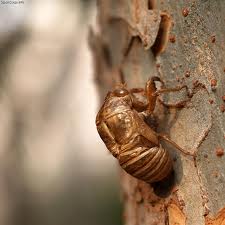
As I set about writing a draft for today, I couldn’t shake my obsession.  As I sat at the desk with my BIC (butt-in-chair), staring at the sad leaves on the tree outside my window, I noticed something.  No cicadas.  I have no idea if they are gone for the season or not, but they’ve been my accompanists these past weeks, and now, silence.  Thus began my drafting.

Listen.  Today the cicadas are silent.

No drilling, persistent rattle,
but plenty of perfect skin-forms
still cling to the siding and trees.

(Eerily, just as I typed the above, I began to hear the cicadas again…I hope I haven’t angered the cicada gods, as I’m not fond of the little buggers or their skins.)

The poem became “Inventing a Rain Spell” as the speaker went about collecting the skins and creating her own ritual to get it to rain.  The poem alternates between single-line stanzas and tercets, beginning and ending on single lines. 

from creativecommons.org

Close friends know that I am, frankly, freaked out by these skin-shells.  My husband, C., likes to collect them in his man cave.  They give me the willies.  Too perfect for me to believe they are dead tissue, I imagine them flicking back to life at any second.  So, the poem was a bit of a departure for me as the speaker actually handles the skins.  Also, just getting the picture for the blog today was grossing me out.  I can’t really look at the image directly.

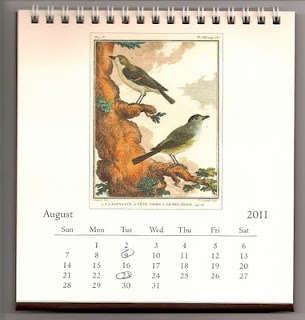
For something prettier, I finished my journal today.  Here’s what it looks like.  BTW: I realize there’s some thing going around the internet about “putting a bird on it” and how women should stop doing that.  Well, pppppplllllllllbbbbbbbbbbbttttttt (raspberries) to that.  I love birds and I won’t stop just because some hipster thinks they’ve become a cliche.  So there.

Posted by Sandy Longhorn
We Interrupt This Program

We Interrupt This Program

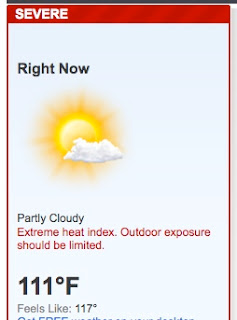
111º ~ with heat index = 117º ~ I do not lie

Yes, I did get a draft under my belt this morning but nothing new to deliver in terms of process notes.  It was all BIC and time to stare out the window word-gathering.

What seems more urgent just now is this.

I clipped this from The Weather Channel’s info on Little Rock just moments ago.  Dear Lord, it’s enough to make one reconsider living in the wintery bluster of the north.

Please, please, please make smart energy choices, friends and fans of the Kangaroo.  Mother Nature is showing us the error of our ways, and I don’t like it. 

Posted by Sandy Longhorn
Draft Process: How to Write about the Death of Your Pet Without Mentioning Your Pet

Draft Process: How to Write about the Death of Your Pet Without Mentioning Your Pet

97º ~ heading up to 103 before the heat index is figured, grab an oxygen tank, friends and fans of the weather, it’s getting hard to breathe out there, the dirt has turned to concrete beneath our feet despite attempts to keep things watered during the night hours

I’m happy to report that so far, I’m on track for a poem a day through Sunday.  Whee.  I’m still starting with Meeks’ Biogeography and letting the poems there help my mind loosen up.  To do justice to Meeks, I’ll need to re-read the book with more concentration later.  Right now, I’m just letting the words and lines crash over me like waves of sound (I tend to read out loud). 

No surprise, then, that today’s draft is “Biogeography: 8/2/11.” 

Dear Readers, I confess that I’ve been wallowing in a blue funk for the past few days and trying to figure out the cause.  I know I’m having some back-to-school stress, but I also had to admit to myself, finally, that I’m still mourning the death of Libby, our beautiful tabby cat.  At the time Libby died, Lou-Lou, our black & white frisky cat, was fighting for her life against an unrelated disease.  Now that Lou-Lou is getting better and is more her old self, the grief for Libby is setting in.  It’s such a minor loss when compared to friends who’ve recently lost human loved ones, but it’s what I have going on in my heart right now, so here I am.

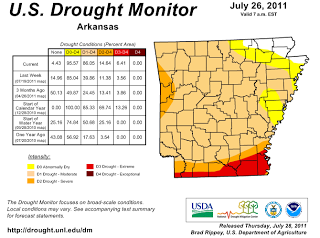
Once again, I managed to take the emotions and facts about the cat and place them in a poem without mentioning Libby.  The last time I did this was when I started “Fairy Tale for a Girl with a Fever of Unknown Origin” and I used some details from Lou-Lou’s medical files for that, applying them to the girl.  Today, I let my sadness for Libby guide me.  I began with noting the environmental conditions (drought), in large part because of Meeks’ influence, and then, I let the poem drift to “This I’ve labeled a killing summer, / although the heat was not / to blame / for a faulty heart / long undetected.” 

from the National Drought Mitigation Center at U of NE Lincoln

At first, I had two chunky stanzas, one of eight lines and one of nine.  I have a habit (bad? good?) of wanting balance in my stanzas but on re-reading there was nothing I wanted to add to the first or remove from the second. This got me to questioning why I’d broken the lines and stanzas as I had.  I re-read (out loud) and realized the poem has a lot of nature in it and a lot of meditation and my mind drifted to Charles Wright and some of his poems with lots of indented lines spread over the page.  I started working through the poem adding more white space and breaking up the chunks.  It turns out, this unlocked even more drafting for me and I was able to trim some of the excess language as well.  Much happier with it this way, even though I recently read someone giving advice to poets by telling them to stay away from the tab key.  To that I say: to each her own!

~~~~~

On a happy note, I had an acceptance for a poem in my inbox this morning.  Wahoo!  Maybe the acceptance dance will also serve as a rain dance today.  A girl can dream.

Posted by Sandy Longhorn
Draft Process: Another Biogeography

Draft Process: Another Biogeography

87º ~ 100, 101, 102, 100, 100: thus read the predicted highs for the week ~ sigh ~ sweat ~ laundry ~ sigh ~ sweat ~ laundry ~ impossible to even run short errands without feeling it

Today’s draft post builds on my last draft post (7/29/11), in which I discussed Sandra Meek’s Biogeography as inspiration.  I’ve read half of the book now and while my poems are drastically different from Meek’s, which take on a more global view from time to time, I am indebted to her for the idea spark.

Today, as I was reading more from Meek’s book, I had my notebook open and ready, not sure where I would go, but wanting to try to draft a poem a day for this week.  So, I kept repeating “I will write a poem” all morning and I held that thought in the back of my head as I read.  One of the things I wrote down in my journal was this:  “Embrace the I.”  For a while now, I’ve tried to distance myself from the “I” in my poems.  I have worked to avoid autobiography and simply write poems inspired by the things I’ve heard, seen, done, experienced, etc. without telling the facts of my life.  I’ve done this as a conscious attempt to subvert the idea of confessional poetry. One of the ways I’ve done this is to use the third person almost exclusively.  Of course, with the nursery tales, that also fit the form.

However, as I’ve been reading lately, I’ve been watching how other poets I admire, Meek among them, work with the “I.”  And you know what…I could care less if they are revealing “facts” about themselves or if they made them up.  I like the closeness of the “I,” the revelation of the speaker. 

After reading another section of Meek’s book, I started having an inkling of where I wanted to go but needed one more push.  That push came by reading over the draft from the 29th.  Again, nothing came pouring out of me and there was a lot of hemming and hawing, but still, I got down a draft: 10 stanzas written in couplets, “Biogeography: 8/1/11.”  It begins:

Traveling to the house of born and raised
is slow going.  I dredge a map from muscle memory

that says north by northeast and tells me
when to turn, when to stop and gather strength.

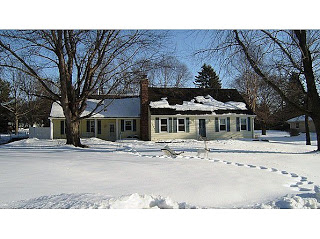
my childhood home, from a recent real estate listing

For now, I’m just happy to have gotten something down, whether it lives or not.  Good blogger & poetry friend Karen J. Weyant reminded me of this when she reported that she’d written a poem a day for July and at the end found she had 16 drafts that might be poems.  Duh!  Headsmack!  I’d let myself fall back into that trap of thinking every draft I began had to lead somewhere final.  I am now reminded that there must be room for failures, for drafts that die on the page; otherwise, the pressure of perfection stifles all the words in my head.  Snuff!

Posted by Sandy Longhorn
Two Days Away from August

Two Days Away from August

93º ~ back in the deep heat cycle with highs topping out at 100º soon, the rain it did forsake us

Technically, we’re about a day and a half away from August, but that lacked the punch I wanted for the title.  Why all the fuss about August?  Several reasons really.

1.  I report back to school on Aug. 8th and students begin classes on Aug. 15th.  The scurry of prepwork looms.

2.  On Aug. 1 many, many lit mags will open their reading submissions for the fall.  Sadly, I did not build up a cache of poems over the summer as I’d hoped.  Still, I do have some strong candidates from the nursery tale series that will be meeting the editorial boards soon.

3.  August also begins the new year of sending out the manuscript.  I am embarrassed to say that this will be my fourth year shopping this book, although it bears little resemblance to the manuscript I sent around in 2008/2009.  I know the individual poems are strong because 90% of them were published in quality lit mags, some as long ago as 2006! 

Many things are more difficult with this book than with Blood Almanac.  

For one, with Blood Almanac being my first book, I was using all of my quality individual poems to shape the manuscript.  Now, having learned much more about putting a book together, I’ve got some great poems that aren’t in the new book b/c they don’t fit.  I also have the nursery tale series, which is something different all together.  I’m feeling much more like an out of control octopus now, with themes and tendrils going every which way.

Another difference is that I’ve made a larger home for myself in the poetry universe.  In almost every way, this is fantastic; however, there is the tiny sliver of competition amongst friends now.  I was just talking about this with a local poet friend as she and I will compete for a local fellowship this fall.  I am bone-honest when I say that I will celebrate without hesitation should she win and not me (and I’ll be thrilled to have someone to commiserate with should we both lose); however, I am also bone-honest when I say that I will be disappointed should I lose and that disappointment will be a bit different because I know the competition.  It is the same with rejection elsewhere in the poetry world, a bit different because I know the competition so much better these days.  However, I would not trade my poetry friends & family for anything.

Also, I really want to share In a World Made of Such Weather as This with my poetry universe. 

I spent the morning back with the manuscript.  I did this in part because I began reading a book by another poet and then Lou-Lou stretched out over the pages and took it hostage.  While petting her, I thought about how carefully I was reading this book (by a poet relatively unknown to me) and how I was annotating it.  I decided to try reading Weather that way, although without the annotations as I could only read it on screen with Lou-Lou taking up the desk.

As usual, I was only able to sustain the deep & distant reading of my own work for a bit, but several surprising things happened.  Frequent readers may remember that I changed up the manuscript in June. Today, as I opened the file and began reading, I was surprised by the order of the opening section and then I remembered that I’d tinkered with the order in June.  This is exactly why I need to wait several weeks when revising.  I need that surprise to jolt me and get me to see more objectively.  I’m happy to say that as I read, I felt much more comfortable with the order of the book.  In some ways, it’s more of a middle ground between the 09/10 version and 10/11 version.  It feels more settled this way and I am glad.

Another thing that surprised me was how confident I felt about the book as a whole.  I really believe in this thing and that may be why the disappointment of rejection hovers and hovers.  With Blood Almanac and with the first few versions of this book, I was confident about the poems but still hesitant about the whole. 

Finally, another poet friend had emailed me a few weeks ago as she reviewed her own proof for an upcoming publication.  Within those proofs she was able to see my poem as well.  She emailed me to compliment the poem and to question if it was in the book (she’d been one of my first readers).  Remembering this, I checked out my files today for any poems that should be in Weather that aren’t.  Turns out, one of the poems I had loved in the 09/10 version had gotten dropped along the way.  Who knows how?  In any case, I got it worked back in and I found two other poems that belong as well.  Again, I just needed more time to gain the distance to see where they fit.  And perhaps in the other versions they didn’t fit, but by tweaking the order, I found an opening for them.

All in all, I’m happy with today’s work and I thank you all for reading and listening to me bemoan the rejection woes.  I know that we all share these woes at different times in our writing lives.  It’s soothing to know I share the writing universe with such wonderful folks!

Posted by Sandy Longhorn
Draft Process: Flailing in the Dark

Draft Process: Flailing in the Dark

80º ~ cloud cover, rejoice! ~ the best chances of rain in weeks, but nothing on the radar yet, I grow impatient for the rain,

Well, friends and fans of the Kangaroo, I must confess that I did not go easily into drafting today.  I tried all my tricks, including pre-visioning the drafting time last night and as I ate breakfast this morning.  I simply couldn’t get excited about drafting.  (In hindsight I wonder if I feel I’ve “finished” my series of tales because I drafted the poem that fits as the last in the group, and whenever I’ve finished a group of work I’ve had to flail around in the dark for a good long while before another spark gains on the tinder.)

I am proud, though, to say that I kept my BIC (butt-in-chair) and slogged through the resistance. 

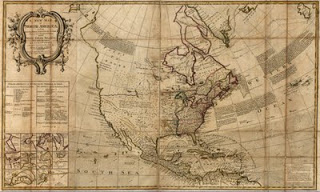
I decided to start with a word bank but instead of using a book of poetry, I challenged myself to use some of the torn out articles and receipts and whatnot from my pile under the printer.  (See image here.)  My first column uses words from an article in a local who’s-who and what’s what for Little Rock.  The article is about a group of young, hip men who formed a hat club b/c they want to have a reason to wear vintage hats.  The club has evolved to being a community volunteer group as well.  The second column uses words from a piece of creative non-fiction from Orion.  The piece is a collage of sentences and brief paragraphs about humanity’s relationship to the earth, to religion, and to each other.  Finally, the last column combines two much shorter pieces: a back order notice from a small press and an ad for a book by Andrei Codrescu.  Imagine my surprise when the word “quicksilver” showed up as part of the street address for the press and as an adjective in the ad.  You know I had to use it then!  One last note, in a recent email exchange with a poet friend, whose husband is a travel & nature writer, the idea of poets who use the word “gossamer” a lot came up (and not in a good way).  So, for fun, I added “gossamer” to one of the columns. 

With my words numbered, I used the random number generator at Random.org and got to making pairs.

It was interesting to see the different types of language crashing up against each other and I got some interesting collisions.  I scribbled out a few rough lines in the journal and thought I was on to something.  Moving to the computer, I typed up what I had and then realized that I wanted to expand on the first half of what I had started.  By the time I had added on to my first two-three lines, the other two-three lines I had drafted with them in the journal, no longer belonged in the poem.  At first I tried to cram them in there, but finally, I re-wrote them in the journal to save for another poem. 

The poem begins:

Years ago, the map of my home
folded in upon itself and creased
along the gossamer bloodlines.

image from creativecommons.org

FYI: map and folded came from the back order notice (Matthew Nienow’s book, The End of the Folded Map); home and creased came from the article about the hat club; gossamer came from my friend’s email; and bloodlines came from the piece in Orion.

Once I started drafting on the computer, I paid less strict attention to the word bank, although I did go back to it from time to time.  I just didn’t rely on the pairings I’d created.  I also let words suggest other words.  So, one of my words from the hat club article was “architect” and it became “draftsmen” and later “architecture.”  My point here is for beginning writers: don’t marry the prompt.  The prompt just gets you going.  Feel free to ignore the rules at any point!

Back to the draft.  It came to a natural closing, and I’m left with a draft that is right in my comfort zone: six stanzas composed in tercets = 18 lines. 

Faced with searching for a title, I read and re-read the draft, aloud.  (Another note to beginning poets…you must read your drafts out loud as you work…poetry is an aural art form.)  As I searched for a title, I remembered reading a blog post that reviewed a group of poems where the poet (sorry, can’t remember who) had titled all the poems with “Notes: the date.”  I realized that the poem I’d drafted had the meditative feel of a journal entry.  When I was in grad school, I drafted a poem titled “Notes Toward a Biography: ‘some date I can’t remember.'”  It never made it past the drafting stage but most folks loved the title.  At first I thought I’d use that.  Then, I remembered the word “biogeography,” which is the title of a book of poetry by Sandra Meek that has been on my to-read pile for far too long.  It will be next up!  Looking up the definition of biogeography, I found this:

a science that deals with the geographical distribution of animals and plants” Merriam-Webster.com

Ah hah!  The poem is now “Biogeography: 7/29/11” and I can see a way to write more of these poems that explore a personal “geographic distribution” as a way to further mine my obsession with my roots while also including the flora and fauna I love.

Posted by Sandy Longhorn
Poetry Reading Styles: A Series of Questions

Poetry Reading Styles: A Series of Questions

86º ~ lots more sun today than in the past few days together, heading back toward 100º for a high, good breezes in the high branches, nothing much in the lower

Over the past few days I’ve been mulling over a series of questions about how poets read their work in public.  These are not new questions and they have been with me for years and years.  I know that some of it is a matter of taste, but I’m wondering what you all think, Dear Readers.

In an oversimplified X versus Y formula the question is, to pause between poems, providing brief anecdotes, or to only read the poems and let them do the talking.

image from creativecommons.org

I have this question as both a poet and an audience member. 

As a poet, I try to find a good balance in the middle.  I try to avoid explaining the upcoming poem because I know that the poem should speak for itself, and as an audience member, it drives me crazy when a poet explicates his or her own poem before reading it.  However, as a poet, I’m not comfortable reading just the poems with a brief, quiet moment in between.  As an audience member, when poets do this, the poems tend to blend together and get a bit “soupy” for me, unless I’m super familiar with the poet’s work. 

This question has resurfaced because I ran into a colleague on campus the other day, and she had attended my reading on the 12th.  She is not a poet and not an English instructor, which becomes part of the mulling.  My colleague stopped me to thank me for providing the interludes between poems.  She said that poetry is so powerful that she needs a bit of down time between poems.  She also commented that sometimes my tiny introductions helped her get into the poems since she was relying on her hearing rather than reading.

Now, of course, my ego shone a bit brighter after talking to her, so take all of this with a grain of salt, but her comment got me to thinking about the poet’s job as it relates to a non-poetry-writing audience.  When we do a reading, who do we imagine in our audience?  Are they mostly poets & writers?  If so, do they need less interluding and more poetry-only?  If there are many folks in the audience who are non-writers, or beginning writers, is the poet doing a good thing by providing “breaks”?

Another comment that has stuck with me since the reading is that one of the library staffers who attended the reading confessed that she isn’t a huge poetry fan but that she enjoyed my book and my reading.  This got me to thinking about our opportunities to widen the poetry audience.  If we stand up and read to the audience as if everyone lives and breathes poetry 24/7, then are we hurting more than helping?  What is the poet’s responsibility?  Does it change with the location / audience?  Does the poet need to adopt different styles at different times?  Is this a “betrayal” of the work?

All of this leads back to the question of accessibility, I suppose, and the poet’s agency in creating a poetry community.  Lots and lots of questions there.  Let me know what you all think, if the questions interest you, of course.

Posted by Sandy Longhorn
Draft Process: Chapbook Final Poem

Draft Process: Chapbook Final Poem

81º ~ cloud cover 80%, 40% chance of rain from t-storms, yesterday’s rain due to t-storm = 10 minutes, we take what we can get

Yesterday was not a good day.  I was hit by the sluggish, couch potato bug pretty hard.  I was also hit by the “oh crap, summer is almost over and I wasted it” bug.  Most teachers are familiar with this one.  I know I didn’t “waste” anything.  I just always start the summer break with lofty goals about what I’m going to accomplish.  It turns out, I don’t do well without a schedule.  This realization has been creeping up on me for the last few summers.  Now, I report back in two weeks but have a lot of prep work to do on classes in that time.  (I’m teaching Comp I online for the first time.)

I think I was also a bit down because I hadn’t written a new draft in a while.  In this case, I was the agent of my own melancholy.  I know the solution: butt in chair.  I simply couldn’t do it yesterday.  Today, now, today is a different story.

I wasn’t even really thinking about drafting.  I was just waking up at the desk, going through my emails and reading blogs.  Then, Lou-Lou came to help me.  Her version of helping is to sit where I need the keyboard to be.  She also likes to be sure to hold down one of my arms by curling up on it.  In the past, I was pretty good about shaking her off; however, we’ve been feeling bad because she no longer has Libby as a playmate, so she’s lonely.  Also, after one cat dying, I’m wanting to give Lou-Lou all the love I can. 

So, as I sat there, stymied by my helper, I realized that I had my right hand free and my journal was in reach.  No excuses now. 

As I flipped open the journal, I came across this note “have all the girls meet in the afterlife.”  It looks like I wrote this note in April.  Suddenly, the lines were pouring out of me.  I’ve called the draft “After” and made it the final poem in the chapbook.  While I didn’t consciously set out to write a “final poem” for the book, I now see that it helps close the manuscript.  So by writing through the poem, I also learned something about the manuscript as a whole.  That’s a first for me.  The poem begins:

In the ever-after, the air sweet
with cut grasses, the girls arrived:

image from creativecommons.org

It’s a bit of a list poem and contains some of the key images from the tales, and it is the most lyric of all the poems in the book.  I found that I loved the fluidity of being back in the lyric poem.  When I’m writing a narrative it seems that the draft takes a lot longer and there are more questions to address during revision (not that I don’t spend a lot of time on revision when working in the lyric form).  Having to marry story and imagery/sound is just really hard for me.

I’m not saying my days of writing the nursery tales are over, but it was a joy to move in a new way today.

By the way, one of my all-time favorite smells is the smell of fresh-cut grass or new-mown hay.  It’s bizarre, but cracked watermelon rind smells the same way to me.  All luscious and alive.

Posted by Sandy Longhorn
What I’m Reading:  Wait

What I’m Reading: Wait

85º ~ another round of bright sun and no rain, no breeze today either


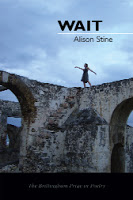
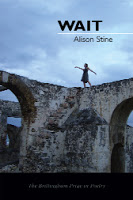
Alison Stine’s second book, Wait, won The Brittingham Prize in Poetry last year and I was able to pick up a copy, I think at AWP.  This is one of my top 5 contests for consistently putting out great books, and it lives up to the reputation with this one.

Wait is all about love and lust, regrets and longing, sex and joy, too.  While there is not a clear narrative arc for the book, there is a consistent speaker revealing the age-old journey from innocence to experience.  Formally, I find the book interesting because Stine moves easily between the single stanza, left aligned block of text and the more airy, multi-stanza, multi-indented lines of text.  Being more drawn to the latter in my own work, I read the former with extra attention to see how Stine made them work. 

Luminescence, each of the poems in this book glows with intense images and powerful feeling that never crosses into sentimentality.  It was almost as if each poem was pulsing with energy and I found myself tearing through the book on my first read.  However, I’m having a hard time summarizing what made me feel that urge to turn the pages so quickly, given there was no mystery or plot pulling me toward the end. 

Here is an excerpt from one of the first poems in the book, “Child Bride.”

It’s different every night.  Your sister
has two days before her wedding, 
but she has been sewing since she was five.
Your cousin is nineteen, but her groom
is sixty.  You risk salvation by squeezing
your eyes.  Now your prophet is wheat
in a rain field.  Now your prophet is acid
and orange.  Love ends in the pocket, a rope
belt untying.

This poem has one of the most haunting last lines ever, but I’ll let you discover it on your own, Dear Readers. 

“Salt” has the same intensity but with the added white space I mentioned earlier.  Here is the beginning.

You were the lover for which I bled.  Comfort me
…..with salt: tears, their silken twin.  Understand
……….I have made my arms doors for you.  Listen:

I love that “listen” followed by the colon that keeps us breathless and urgent at the end of the line.

One of the most heart-breaking poems in the book has the speaker detailing a miscarriage.  Again, what stands out here is not only the powerful language but the ability to avoid the overly dramatic sentimentality that the subject matter could easily cause.  Here is an excerpt from “The Red Thread,” and for clarity, the speaker is in the shower.

A red snake coils at the bottom of the drain: our child,
……phrased like a question.  The plum tree in back

………..ruptured in blight.  Still, I could say nothing.

My favorite poem of the whole collection may just be the very first poem, “Wife.”  In it, the speaker recounts a childhood filled with the urge to rush into adulthood, into sex really.  She states, “I got in a car / for a strawberry cream” and later “I wanted / to be dancing.”  By the way, that line break on “wanted” is brilliant as it sums up that restless urge of the teen years.  However, the speaker then admits her regret for rushing into it all as she addresses her husband and wishes she had waited.  She states:

………………………..I would have curled
………..in a rabbit whorl, a mouse nest,
in a leaf-spilled shade.  I am a bird
…….in the field and I want you to find me.
…………I want you to find me.  Tell me wait.
Support a Poet / Poetry
Buy or Borrow a Copy of This Book Today


Posted by Sandy Longhorn
Three Links and a “Coming Soon”

Three Links and a “Coming Soon”

84º ~ morning light over my shoulder, crisp clouds well defined, a tease of a breeze

I’m currently giving myself carpal tunnel by typing OVER the cat’s long body stretched in front of the keyboard.  Too much loss and sickness means she’s getting her way for a while yet.

Three links to pass on today.

1.  Animated book covers, yep, we’re there.  This is pretty cool and thanks to Julianna Baggott for sharing the link to hers this morning.

2.  South Dakota Review announces a new editor.  Welcome to Lee Ann Roripaugh, only the 3rd editor in 48 years and the first woman.  Wahoo.

3.  Jake Adam York contemplates the act of leaving a book or journal behind while traveling in a post for Best American Poetry.  I’m a huge fan of leaving a journal behind when traveling or even when just at Starbucks or anywhere around town really.  I’ve left one behind at the Jiffy Lube, just in case people find themselves intrigued while waiting for their oil change.  I couldn’t leave behind a complete collection, though, unless I purchased extra copies of my favorites, and I don’t earn enough cash for that plan yet.  (BTW, I think I startled Jake when I told him that I left my copy of Copper Nickel on the plane to AWP.)  Oh, and I have a habit of ripping out the poems I really love or copying them out in my own journal if they are short.

Coming soon: a response to Alison Stine’s Wait.  I have to go to work for a meeting today so I’m delayed.  What’s that you say?  Teachers / college professors don’t work in the summer?  Yeah right…we just work OFF CONTRACT, which means for free.  Ahem.

Posted by Sandy Longhorn