Draft Process:  Haibun #3

Draft Process: Haibun #3

80º ~ heat wave continues, may get a ‘break’ on Wed/Thurs, when the highs will only be in the low 90’s, long-live the South, it may stifle, but at least it doesn’t freeze

I’m happy to be back in drafting stage, here at the desk of Earnestine, my kangaroo guide.  I’ve toyed with declaring a poem-a-day goal for a set number of days, but I’m just not feeling it.  I think I’m doing well as I am, so we’ll see how it goes.

For today’s session, I did practice my mental gymnastics of telling myself “I’m going to write a poem tomorrow morning” all through the evening yesterday and then “I’m going to write a poem this morning” as I went through my morning routine.  Believe me, I am happy to be writing and drafting, and I do feel like I have things to say, so this is not an attempt to force the issue.  Rather, I find that it helps me focus and turn off the monkey mind that tends to plague me.  I also keep a notepad handy so when a monkey-mind thought pops in, say something I need to pick up at the store, I can jot down the reminder and put it aside.  Hey, it works for me.

So, I came to the desk this morning and cleared it of everything except my journal and my folder of poems in progress.  I minimized all screens on the computer and set the iTunes for classical music only.  The stage was set. 

Given my review of Mary Biddinger’s chapbook of Monica poems yesterday, I’ve been thinking more and more of making a chapbook of my cautionary/fairy/haunting tales.  Yesterday, I’d counted up the pages I have and I’m pretty close to being there, but two of the poems feel a bit weak.  I thought I’d return to that form this morning, although my girl persona hasn’t really been singing to me much lately.  I flipped back in my journal to the jotted lists of Midwest icons that resulted from Kristin’s comment back in March.  The first word I saw was “windmill,” and this line materialized:

No Don Quixote windmills these…

I jotted down three lines from that and then got stuck, so I went back to my list of words and found Rath Meat Packing (a plant in my hometown that went out of business during the farm bust of the 1980’s, but that was a fixture of my childhood).  So, I started a tale about a girl whose father worked second shift at Rath’s.  It lasted for four and a half lines and went nowhere. 

Mental gears grinding, frustration level rising.

I opened my folder of in-progress poems to see if that would spark anything.  I got sidetracked with a few minor revisions, which turned out to be exactly what I needed.  Just playing around with lines that already existed was like adding oil to those stuck gears.  I took a glance at, but didn’t read, the two haibuns that I’d drafted most recently, and then things just clicked into place and I knew I had to write another “Cornfield, USA” haibun.  I went back to my windmill image and off I went.  I’m not sure how sturdy these haibun are, given that the form is new to me.  Time will tell.

For someone who used to swear she never wrote poems in a series, ahem, I seem to be doing just that now.  Who would’a thunk it?

Finally, as I prepared to draft this post, I knew I wanted an image of a modern windmill, but I’d forgotten to take one on my last trip up home.  Many thanks to Michelle, of reunion fame, for telling me about creativecommons.org, a site that offers images and text for use because the owners of the material have said it is okay.  I had to settle for an image from China, but these are the type of windmills the poem is about, so there you go. 

Posted by Sandy Longhorn
What I’m Reading:  Saint Monica

What I’m Reading: Saint Monica

90º ~ reports of temps over 100º all around town yesterday, but not on our official record yet, the robin labors on the nest (not a mammalian labor, of course), no rain for days and none in sight, so far all green things are holding fast to the remains of last month’s floods, dead calm

Mary Biddinger is one of those poets who seems always to have been with me.  I could not tell you when I first came across her name or her work, whether it was from reading a poem or seeing her name as editor.  She is one of those amazing multi-talented people who seems to do it all: raise her beautiful children, write amazing books of poetry, edit the journal Barn Owl Review, direct the NEOMFA program, and teach at the University of Akron.

I’m pretty sure she’s a superhero.

I know she’s a superhero poet.  For full disclosure, I reviewed her first book, Prairie Fever, here

Saint Monica is a chapbook, recently released (as in, I can still smell the glue on the binding and the ink setting on the page) by Black Lawrence Press.  Weighing in at 18 poems of one or two pages each, this is a mighty chapbook, and I suspect that the poems may be composed of the theoretical dark matter; they drag me in and weigh heavy on my heart.  They are a black hole in the best possible sense. 

(If you are a scientist and I screwed up those metaphors, I beg your forgiveness.  Feel free to leave a comment of explanation!)

As I mentioned in my review of Lee Ann Roripaugh’s On the Cusp of a Dangerous Year, I admire the well-used epigraph.  Biddinger offers us the entry for Saint Monica from the Patron Saint Index, and in doing so, sets the tone for the book and prepares us for some of the more difficult content to come.  Aside from the biographic details, we learn that Saint Monica is the patron of such people as:  abuse victims, alcoholics, disappointing children, housewives, victims of adultery, wives, &etc.

Each poem title begins with “Saint Monica…”  For example, we have “Saint Monica of the Gauze,” “Saint Monica Gives It Up,” and “Saint Monica and the Itch.”  Each poem is a persona poem featuring Monica, a girl of working-class heritage, and we see her progress from childhood to a difficult adulthood.  Several poems weave an alternate life for Monica, a life in which she chose a different man, a better man.  These are narrative poems written in a well-balanced variety of forms.  There are couplets and tercets and longer stanzas, and there are several prose poems. 

One of the things I admire most about Biddinger’s work is her ability to write narrative poems without losing the music of the well-chosen word.  Here are a few excerpts of “Saint Monica of the Gauze,” the first poem in the book, as example.

the opening:

The room is red with iodine.  Her ears stop
and her thighs slacken against 
the bed.  The owls would like to unwrap
her, as owls do, always looking
for the next loose shutter … .

the closing:

…They say that she will get out.
There will be time and muscle
enough for hanging wet towels on a line.

Listen again to “slacken against” butting up against “unwrap” and the way “next loose shutter” sounds like a stutter.  Then, at the end, hear how “line” echoes “time” and “muscle” works with “wet towels” to give us that sense of a girl wrung out by life.  The whole book is filled with this kind of subtle music building a dirge for Monica. 

Perhaps the most blatantly heartbreaking poem in the book is a prose poem, “Saint Monica Stays the Course.”  It is too lengthy to quote in its entirety here, but we get the overview of Monica’s life very early in the book.  The poem begins with Monica as a girl having been granted the privilege of walking in the May Crowning procession and receiving instruction on what to do in case someone passes out or gets her period or pukes along the way: “whatever happens, do not stop marching.”  Variations of this phrase “keep marching” are repeated throughout the poem (and throughout Monica’s life), providing a key poetic element in the prose form.  Later the refrain is lengthened to include “proceed as planned,” and the setting moves to Monica grown up, now with a job as a cocktail waitress and an abusive man in her life.  The poem ends with a description of physical abuse and then this:

If he appears above you in the middle of the night, reeking of Wild Turkey and Kools, do not push him away.  Proceed as planned.  You have done this before.

Ah, sweet Monica, you are so like many of the girls/women I’ve known, both personally in my youth and now in my job as a community college instructor, these women who become trapped in a brutal life because they were told from their childhood that this was their fate, that they are to blame for their own bad choices and must take whatever comes as a consequence, that they will always be doing penance with no hope for redemption. 

Towards the end of the book, we do find some joy in Monica’s life, some hope for the future, in her son.  Biddinger writes in “Saint Monica and the Babe”:

Since the day he was born he was never
quite real.  Monica keeps him in
her bed at night, won’t share him
with the crib rails or midnight creaks.
She wonders if she should pray to him,
ask him questions nobody could answer.

The poem is bittersweet, as Monica seems to be placing an unbearable burden on her son, but for a moment there is tenderness and love there.

Throughout the book, Catholicism lingers in the background.  While the poems do not judge the Church and its rites, they do ask the reader to question the relationship between Catholicism and the working-class characters in the book, especially the women who seem to take on suffering like a shroud. 

Support a Poet / Poetry
Buy or Borrow a Copy of This Book Today

Saint Monica
Mary Biddinger
Black Lawrence Press, 2011

***Remember that if you buy directly from the press, they make a ton more money and will be more likely to stay in business.  If not the press, consider buying from Better World Books, which offers discounts comparable to those of the major chains and uses its profits to promote literacy in the US and abroad.

Posted by Sandy Longhorn
The Narratives of Our Lives

The Narratives of Our Lives

85º ~ highs in the mid to upper nineties for the next week, at least, possibly 100 on Monday, oh joy, summer has obliterated any little bit of spring we had left, the robin on the nest pants continually to try to stay cool, the eggs may hatch early due to the heat, according to my sources

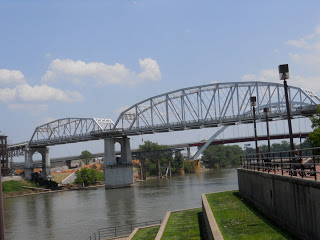
Where I’ve been?  Lebanon, TN (30 miles east of Nashville).  Why?  Reuniting with a college roommate (hi, Michelle!). 

one of the Nashville bridges

Like many people in the pre-email, pre-Facebook days, Michelle and I graduated and kept in touch for a few years.  Then, life intervened and we drifted apart.  We were living half a continent apart, when long-distance phone calls were still expensive, and both of us were starting careers and working on relationships. 

Luckily for me, when my book came out and Michelle read about it in our alumni newsletter, she emailed me and we reconnected.  Emails were great and then Facebook made things better.  Last year, I took a look at the map and realized that we both live on I-40 and that somewhere east of Nashville would be halfway.  The planning began.

On Tuesday night, we saw each other in person for the first time since 1994, and, magically, we picked up right where we left off.  We talked and talked and talked and walked in some heat while we talked, ate in some diners and restaurants while we talked, and drank coffee in one excellent bakery while we talked.  While we had filled each other in over email on the basics of our lives, there were lots and lots of gaps, lots and lots of stories that needed telling. 

As I drove home yesterday, I thought about the narratives of each of our lives, and how we chose to tell them.  We were not chronological.  Our stories skipped like rocks on a flat Minnesota lake.  Luckily, we had bonded at that age just between our youth and our adulthood, and so we had a lot of foundational knowledge about each other.  I also thought about how I framed each of my stories, trying to be honest and thorough.  This is one of the amazing things about a true friend: that even after nearly two decades, I was still comfortable talking intimately with Michelle and I knew that she would treat my narrative with care.  Michelle is one of the most amazing, talented, and caring people that I know, and I am so thankful that she is back in my life!

~~~~~

Now, aside from a brief and nearby weekend trip, I should be settled down at home for at least a month.  Expect the poetry to begin churning!

Posted by Sandy Longhorn
Miscellany

Miscellany

82º ~ a smothering air returns for the unofficial start of summer, highs will reach the low to mid nineties all week, clear skies, and just a touch of breeze to tempt us all

Only a brief note today.

First, here’s a link to another great Roxane Gay post about the male-centric world of publishing:  The Well Read Man.  I can’t believe we have to keep having this conversation, but we do.  Gay makes some great points.

Second, I’ve been remiss about announcing acceptances here lately, so here’s a bit of joy-joy to share.  In the last month, I’ve had poems accepted by diode, South Dakota Review, and Cincinnati Review

To share a bit for beginning writers, diode is the odd duck in the mix in that I’ve had poems accepted there three times, which is every time I’ve submitted.  Something about my work really clicks with the editors, which is awesome, although I don’t submit too often so as to not wear out my welcome.  Both Cincinnati and South Dakota are more true to form.  I first published poems with them in 2005 and 2004, respectively.  In the intervening years, I’ve been rejected four and two times, respectively.  This is much more the norm.  Some of my work clicks some of the time. 

Regardless, I give all praise and thanks to the first-readers and editors of all three publications. 

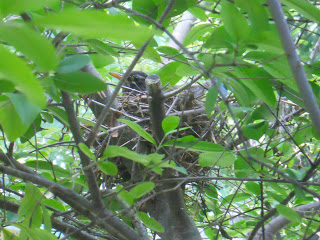
Finally, here’s a photo of the robin’s nest outside my writing window.  Should see baby birds in about 10 – 14 days.  Ooooooooh, the anticipation.

Posted by Sandy Longhorn
What I’m Reading:  Sharks in the Rivers

What I’m Reading: Sharks in the Rivers

64º ~ weak sun but no wind today, one more cool day before a bit of heat sets in, the robin is on the nest more regularly now (at the beginning of the week, there was still some nest building going on), so I suspect there are eggs in there doing their egg-thing

I confess, Dear Reader, I have a bit of a poet-crush on Ada Limón.  I saw her read poems from Sharks in the River at AWP Chicago, when was that 2008? 2009?  And I’ve been looking forward to reading the whole book ever since.  It’s a shame on me that it took me so long to buy and read the book, which came out in 2010, a testament to a busy life and just how many new books of poetry come out each year.  (One of my summer resolutions is to seriously thin-down my to-read shelf!) 

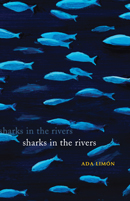
Sharks in the River does not disappoint.  First, it is a beautifully made book.  Milkweed Editions has long been a favorite of mine, ever since my undergrad days in central Minnesota (they are based in Minneapolis).  Limón’s book has just the right heft that says it was made with care.  The cover is a glossy blue, fish-cover, and the weight of the cover stock, and the pages themselves, is luxurious.  It’s a paperback with both the front and the back cover containing folded over bits.  I know there is a term for this, something French maybe, but it escapes me at the moment.  Finally, at the finish of the book, I found a statement about the environmental benefits of printing the book on 100% post-consumer waste paper.  (Yes, I read every page!)  Four fully grown trees were spared, not to mention the savings of water, solid waste, and greenhouse gasses.  Amazing!

I know, I know, the quality of the poems is what really matters, but I must praise this book as object as well.

Now, to the poems, these are my back page notes:
a lament to the world
stones & rivers & rain & birds
elegy, loss, melancholy
nostalgia for the natural world
attempt to capture fleeting happiness
confronting what we fear
what is love?
how do we love?
always trying to strip down to the naked truth

The speaker of these poems moves between worlds both urban and natural, but seems most closely connected with that natural world as she attempts to make sense of the fragile human life.  The poems exude a sense of spirituality but not religion, per se.  The speaker struggles with faith in a more abstract way than by naming any formal religion.  Here is a 21st century existentialism mixed with a bit of transcendentalism. 

As one example, here is the ending of one of the first poems, “Flood Coming,” which strikes home more forcefully given the ravaging floods that recently invaded Arkansas.

What’s left of the woods is closing in.
Don’t run.  Open your mouth big
to the rising and hope to your god
your good heart knows how to swim.

While most of the book is made up of one- to two-page lyric poems, the third section (of four) is a stunning long poem, “Fifteen Balls of Feathers,” that weaves in various central American myths about hummingbirds. In the sections of this poem, the speaker deals with the coming death of someone close to her.

In section 1, we get the following:

I wanted to be a hummingbird.
………It made sense to long for rapid wings and the ability to hover always–
….
Sometimes though, the thought exhausts me and
……………….I want to be a slow horse, a tennis shoe.

In section 14, this:

This is not a unique story–
……….what we have in our hands is an unsolvable thing.
It’s the passage that perplexes us,
………………..this full weight that must take us down.

Throughout the book, the speaker seeks to balance joy and grief, a sense of longing and a sense of contentment.  She is a seeking voice, an unsettled thing that both desires and fears becoming settled. 

As I mentioned in a previous post, I’m struggling to order my own book of lyric poems, and I think Sharks in the Rivers will be a great model to come back to in order to study the placement of the poems.  Today, however, I fell too deeply in love with the book to study it.

I’ll leave you with the ending of the penultimate poem, “World Versus Girl.”

Maybe not now, maybe not tomorrow,
but this stubborn monster-girl, gone all wrong
……..with the river’s sledge, is not
……..giving in to your one-way-ness.
World, turn all you want to,
……..faster even.  I’ve come to like the way the breeze feels
……..as it rips me limb from limb.

Support a Poet / Poetry
Buy or Borrow a Copy of This Book Today

Sharks in the Rivers
Ada Limón
Milkweed Editions, 2010

Posted by Sandy Longhorn
Draft Notes:  Two Haibuns for Aimee Nezhukumatathil

Draft Notes: Two Haibuns for Aimee Nezhukumatathil

77º ~ a humid wind is whipping smartly through the trees, the robin sits on the nest directly outside my window and turns its head when the branch shifts more than seems comfortable, I hope bird, eggs, and nest stay safe, one more round of severe weather threat this afternoon and then smooth sailing (if hot & muggy) for a bit

Glory be to the drafting gods & goddesses, their saints & their minions! 

While I hadn’t *planned* today as a drafting day, I felt the return of the urge to get pen on paper as I began the morning.  I started with reading Joy Katz’ lovely chapbook The Garden Room, which won the Snowbound Series Chapbook Award from Tupelo Press and appeared in 2006.  The poems are densely packed, short lyrics, paying an homage to Gertrude Stein’s Tender Buttons, although more direct than Stein’s.  Katz’ poems have such precise and beautiful language that when I finished the book and noticed I felt the need to draft, I decided to start with a word bank and the random number generator to make new word pairs. 

Alas, while I fell in love with many of my word pairs and even drafted six lines, that draft died on the page.  I did type it up and print it out, but I did not save it.  Maybe something will come of the lines, maybe not.

Then, I flipped back a page to the notes I took Monday when I read Aimee Nezhukumatathil’s article in American Poet about the haibun form.  (No link to the article available yet, but the journal comes from The Academy of American Poets.)  Both Aimee Nez. and Jeannine Hall Gailey have written about the form before and I’ve tried my hand at it one other time (see this draft note).  The current article elaborates on the nuances and subtleties of the form, and on Monday as I read it, I was already thinking of a return.

Typically, the haibun (a Japanese form) centers around landscape and is formed by a prose poem followed by a haiku.  The elaboration in the article taught me that the form also focuses on aware (ah-WAR-ay), a sense of longing or sympathy important in haiku.  The haibun allows the writer to explore those feelings in a more sustained way, while still keeping the haiku at the end.  This was a revelation to me, and on Monday, I went back to my first attempt and tinkered a bit to fine-tune that sense of longing.  Then, I read this section of the article again.

“This form lends itself beautifully and elegantly to those (like me) who move frequently across the country and even the globe.  But for those who haven’t or don’t, this form is also perfect for re-imagining landscapes seen every day or thought of as ho-hum (strip-malls! suburbs! Cornfield, USA!) into something with a little bit of an edge, perhaps with a darker and more somber, even a more magical, twist.”

Well, without even knowing it, Aimee Nez. had thrown down a gauntlet to me.  On Monday, I wrote in my journal “Do haibun for recent trip?” (meaning my recent trip to Iowa/Illinois, the landscape of my obsession)  Today, after the failed word bank draft, I saw that note and the notes I’d taken on the form and I started off on a haibun titled “Cornfield, USA.”  I drafted one and then worried that it was too obvious, so I went back and drafted “Cornfield, USA II.”  Oh my, I sniff a new obsession (ahem, series) in the works. 

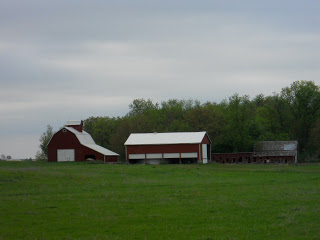
The corn was just beginning on my trip, so here’s a barn instead.

Granted, both poems only take up half a page each, but I’m still thrilled to get the words moving across the page again and feeling that sense of discovery and delight as I see where the poem wants to go.

Woo Hoo!

Posted by Sandy Longhorn
BIC

BIC

74º ~ it’s a soggy one out there friends and fans of the Kangaroo, severe thunderstorms all morning, now clouds and humidity like a lung-cloak, Little Rock’s new motto: The Sauna City

Rowers on the Mississippi in the Quad Cities, IL/IA

Today’s work at the desk has been all about the BIC principle.  That’s Butt In Chair for those not in the know, one of my guiding rules of writing, and the rowers pictured above demonstrate the rule so well.  I’ve been dilly-dallying a bit over the past few days and giving in to the inertia of couch-lounging.  This always leads to bouts of guilt, guilt, guilt about not getting good poetry work done while I have the time.  After all, during the school year, I cram the poetry in wherever I can and promise myself that I’ll “write all summer.”  To fail to use a free day for poetry must be sin, right? 

Yesterday, I made a poetry to-do list to try and contain the guilt.  This morning, after my usual Sunday jaunt to the grocery store, I took a deep breath and put my butt in the chair.  First on my list, a big one:  Submit Poems.  Just two words, a straight forward mission, easy-peasy, right?

Not so much. 

First, I opened my Excel spreadsheet of journals and highlighted all the ones that seemed to have current reading periods.  (More on that “seemed to” in a bit.)  Then, it dawned on me that I needed to know what poems I had available to go out in order to make some decisions about journals.

So, I grabbed the stack of folders that had been building up in a pile on my desk after recording rejections and began my review.  I went through a dozen poems and most of them needed minor tweaking of word choice here or linebreak there.  One poem, one that I’ve loved a lot since the end of last summer but hasn’t gone anywhere, suddenly rearranged itself on the page and I saw the solution.  What had been three solid and longish stanzas is now broken up on the page and indented here and there.  The subject is one of heaviness and a bit of magic and the dense stanzas were making the whole thing too heavy to sustain.  Another poem saw some deep cuts and then a decision to put it on the DL (disabled list for those non-baseball fans out there) for a bit and come back to it later and see if its healed up some.  And, yes, one poem made it from the minor leagues to the majors (moving from the in-progress folder to a folder of its own).

The revision process consumed three hours; however, I was so engrossed that I didn’t even feel the time pass.  Heavenly!

Finally, I went back to my list of journals and started investigating those that I’d highlighted.  Guess what?  At least three major journals that used to read year round now have reading periods from Sept – April.  Several others now have “submissions closed” signs up due to backlogs.  No matter how much I tend to my spreadsheets, I have to spend quite a bit of time updating this information whenever I sit down to submit poems.  On the other hand, I also discovered quite a few journals that used to be steadfast postal-submissions-only folks that now use online submission managers.  Woo Hoo.  To recap:  reading periods shortening; online sub systems gaining strength.

Where things stand now:  3 X 3 X 3.  I have three stacks of three poems each matched up with 3 journals for each stack.  Tomorrow, I will do the sending out, as my BIC rule has resulted in certain muscles beginning to ache.  Still, the BIC produces amazing results, so I’m not complaining (too loudly).

Posted by Sandy Longhorn
A Return to Optimism

A Return to Optimism

80º ~ the air thickening, unsettled weather predicted through the weekend, sky darkening quickly after sun earlier

Hennepin Canal Lock 24, Geneseo, IL

Just a quick progress report from this morning’s time at the desk.  While I haven’t gotten back to drafting poems, I feel the process gathering strength as surely as I feel the wind becoming heavy with the oncoming rain.

This morning, I returned to optimism and submitted the book to three contests with due dates in June.  I know that yesterday’s post showed some doubts; however, those were global doubts that I’m not going to solve in a few weeks.  I figured I might as well roll the dice while I’m mulling things over.  After all, I’m not displeased by the book, just uncertain.

The task of submitting the manuscript might seem quick and easy, given that I’ve gone over it so many times; however, there is still the time of research and adjusting to new guidelines.  Yes, I’m one of those people who read all the guidelines, including the fine print.  Having taught for over ten years, I know the frustration of receiving material when it is clear that the submitter has not bothered with the guidelines.  To the editors and readers of contest manuscripts out there, I say:  Respect, mon!

Blissfully, two of the three presses now accept online submissions, so once I sorted through all the dos and don’ts I was rocking along there.  The other submission is stuffed and sealed and ready for my next task, a trip to the post office. 

In the morning’s work, I also took care of several items on the business side of publishing individual poems.  A journal sent me proofs last night for two poems set to appear in a summer issue.  I love having the chance to check out proofs and give a hat-tip to those journals that offer them.  Also, I have a poem appearing in an upcoming anthology, so I had to fill out a contract, which involved going back through records and checking for permissions and generally getting several ducks in a row.

The point of this post is mostly for those beginning writers out there.  There’s just no getting around the fact that to be a publishing writer, one also has to deal with what might seem pesky and time-consuming busywork.  However, I do believe that by following directions and meeting deadlines, I’m generating goodwill with all of my editors out there.  Sure, I’m not getting rich with these publications, but most of these editors aren’t driving fancy sports cars and taking around-the-world vacations either.  We do it “for the love of the game.”  If you don’t love it, don’t play.

Posted by Sandy Longhorn
Forest: Trees

Forest: Trees

71º ~ bright sun shining down through fully leafed trees, a nice breeze stirring

I am returned from my trip up home and am ready to dive back into poetry.  Today’s the day, woo hoo!

As most of you know, I’ve been working on and sending out my second book, In a World Made of Such Weather as This, for several years now.  It has landed in the semi-finalist and finalist pile several times, but so far, no joy.  Last fall, it went through a major reno (as they say in the housing business), which I detailed here.  All through the spring semester, I’ve wanted to go back to the book and see if the new order still worked for me.  Alas, this takes a very quiet mind and the semester got away from me. 

This morning, I sat down with the book and read it cover to cover, quietly, calmly, slowly, making notes and observations along the way.  My conclusion:

Wild Cat Den State Park, near Buffalo, IA

I am someone who cannot see the forest for the trees.  I love each and every poem in my book and I’ve tinkered and tinkered with them to get them to grow as tall and strong as these trees in Wild Cat Den State Park (with thanks to Sean & Kirsten for taking me there on my recent trip).  However, I have the most difficult time seeing the whole of the book. 

Yes, I can answer why each poem is where it is, and I know what links them one by one, but I have a hard time figuring out if this is the “right” order.  I liked my original order just fine, although it was very literal and stiff.  Once this was pointed out to me by good friend & poet, Stephanie Kartalopoulos, it was obvious, but I never would have seen it without her.  Now, I really like the new version, but I’m nervous that there’s something else I’m missing, even though I’ve had several other readers check it over.

Some of this confusion results from the fact that I’ve just exchanged manuscripts with another good poetry friend, and I’m trying to read his book the way Steph read mine, with the strength of the whole taking more importance than the strength of each poem.  I love the fact that I have such great poetry friends who are willing to exchange poems and manuscripts, since looking at and critiquing their work makes me learn how to critique my own.  This is a lesson I’m always trying to teach in creative writing classes, the value of the workshop, and it’s great to be reminded that it really does work outside the classroom.

This is also a lesson on perseverance.  So, this “looking at the whole” thing is not my strong suit, well then, I just need to practice.

I’ve commented before about my tendency to write poems that land closer to the lyric end of the lyric-narrative spectrum, and I think this adds to the issue.  The speaker of these poems does journey through an emotional ‘arc’ if we must call it that, but there is no clear timeline and no clear conflict and resolution as there are in many books based more on the narrative side of the spectrum. 

At least this gives me one place to begin my practice.  I need to look at books of mostly lyric poems and check out how they are ordered.  Maybe that will help.  Maybe I’ll just see more trees, but the walk will be beautiful, no matter.

Posted by Sandy Longhorn

$84

conditions the same

I’m proud to announce that I’m sending a check for $84.00 to the American Red Cross for disaster relief in the wake of tornadoes and flooding in the south.  Many thanks to Ash, Katie, and Karen for purchasing Blood Almanac during this fundraiser.

Posted by Sandy Longhorn