What I’m Reading:  On the Cusp of a Dangerous Year

What I’m Reading: On the Cusp of a Dangerous Year

68º ~ storms are creeping up on us today, just as the floodwaters start to recede, no major accumulations expected at least, all green things are thriving where not drowned out

It’s a slow re-entry to poetry, my friends.  As most of you know, teaching can sometimes consume one’s life, and when the semester ends there is a long list of tasks that have been put off.  I’ve been inching my way through the task list and getting my head cleared for a summer of poetry.  Tonight is graduation and tomorrow I’m off for a bit of a family trip.  (Sadly, C. will remain at home since he’s still got a month of school to go.)  When I return next week, I plan to start a draft-a-day challenge.  I think, 10 days this time around.  We’ll see.

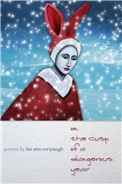
For now, I must report on the latest book I’ve been reading:  Lee Ann Roripaugh’s On the Cusp of a Dangerous Year, which is simply a delight.  This is another stunning volume put out by Southern Illinois University Press, and, according to her bio at the University of South Dakota, this is Roripaugh’s third collection of poems. 

Normally, I’m ambivalent about epigraphs; however, in the case of On the Cusp of a Dangerous Year, the epigraphs work perfectly.  The first is from the opening of Sei Shonagon’s The Pillow Book, which explains how Shonagon came to record a journal of her personal observations of “odd facts, stories from the past, and all sorts of other things, often including the most trivial material.”  The second is from Murasaki Shikibu’s The Diary of Lady Murasaki, in which the narrator observes a winter scene and then muses on the changing seasons and wonders how her life will turn out.  For those unaware, both of these books are from Japan from the 10th/11th centuries.  The epigraphs set us up for a book of close observation of the natural world along with a speaker unsure of the future. 

Like Sei Shonagon in The Pillow Book, Roripaugh writes list poems such as “Sqalid Things,” “Luscious Things,” “Salty Things,” and “Things that Cause a Feeling of Chagrin.”  These are my favorite poems in the book, although Roripaugh does intersperse them with other more narrative work to break up the pace of the book.  The resulting work is an exploration of themes of love, longing, desire, and a speaker on the cusp of something turning, something changing, as the title of the book states.  In the poem “Notes on the Cusp of a Dangerous Year,” we discover “Thirty-seven, the year Lady Murasaki called / the dangerous year, approaching . . . .”  And so, we have the sense of the speaker aging without having settled into a steady life.  In fact, one of the last poems in the book “Chambered Nautilus” explores the speaker’s need to change apartments every few years in an attempt to start over, to begin fresh, to make sense of the past.  She states:

[T]he new apartment is a puzzle
I reassemble–from old scrap parts,
the accumulated detritus
from all my past selves–into somthing
that’s new and hopeful, that denies defects,
or at least disguises them as being
something else…

This is one of the rare poems that focuses on the speaker’s indoor life.  Most of the poems are set outside, if not in a rural environment.  Throughout the book there are exquisite descriptions of insects that are used as extended metaphors for the speaker’s own desire.  She sees in the insect world, an abundance of species willing to hurl themselves towards death in the name of desire, and she doesn’t shy from using lush adjectives and intense sound play in her descriptions (oh, poet after my own heart).

For example, here’s the opening of “Disconsolate Things.”

The dull dusted thud of powdery moths,
somewhat like the weight 
of a fat summer raindrop, striking their
plump, furred bodies up
against a lit windowpane–the muffled
sound, a strangled
rupture, like hot bright kernels of popcorn,
incandescent,
blooming into stark white clouds.

Everywhere in the book, Roripaugh celebrates insect life.  There is the celebration of sex in pollination that echoes the speaker’s own desire, and for most of the book that desire remains unfulfilled so there is a heightened sense of longing and need.  In “Marvelous Things” we get “The scree of insect song scrimshawed into // the night’s horizon.”  Uhm…wow!  Then, in “Cecropia” (the silkworm moth), we get this:

To even try to describe the terrible voltage of
those pheromones–emitted in pulses
plagiarizing the human heartbeat’s blank iambic
a few hours before dawn–would be to fully understand
raw need, desire’s soft dank underbelly.

And later in the poem:

His antennae hear the scent like drumbeats,
like the hot siren glitz of electricity sizzling
the nervous system awake until the body is transformed
into an incandescent singing hum
that flies alight, weightless without the burden of too much
thinking. 

This, I think, is the heart of the book, the speaker’s desire to shed all the thinking about relationships and just sink into the pleasure of sex.  This is complicated by the fact that the speaker’s lover is absent, and one gets the feeling that there has been a breakup, although that is never spelled out in the book. 

Lest you think the book is entirely of the natural world, I should mention that one of the things I admire most about the work is that Roripaugh acknowledges and marries the urban world with the natural world.  While I haven’t quoted any of these lines, there are moments when Hy-Vee and I-80 intercede on the plants, insects, and birds, when the speaker is shopping for groceries or in the car and yet she always returns to the natural world to record her sense of wanting and waiting for whatever is coming next.

I’ll leave you with the end of the last poem, “Things that are Filled with Grace.”  The poem ends with a question and, perhaps, a more hopeful glimpse of the future.

How do bees
know which egg to select for their new queen,
nurse bees ladling
royal jelly over the larva once
she hatches, sealing
shut the royal chamber with wafers spun 
from wax and silk?  They
let her slumber for seven days before
she’s reawakened:
a lambent, ambered incandescent bride
and queen, obsessed by
a hard-wired and fearless desire to throw
herself at the sun–
fierce and elusive in her skyward flight.

Support a Poet / Poetry
Buy or Borrow a Copy of This Book Today

On the Cusp of a Dangerous Year
Lee Ann Roripaugh
Southern Illinois University Press, 2009
Posted by Sandy Longhorn
What I’m Reading:  Town for the Trees

What I’m Reading: Town for the Trees

70º ~ highs topping out near 90º today through Wednesday, cloud-cover today but no news of impending rain, floodwaters still rising, I-40 still closed between here and Memphis, disaster of epic proportions for the eastern half of the state but with less drama than the tornado outbreaks, still many have lost all

Many thanks to those who stopped by to comment after Friday’s post.  I spent much of the weekend in recovery mode and am feeling refreshed and energized today.  Now begins the long haul of seeing C. through the end of his semester, as he has the more grueling schedule of a high school teacher. 

And there is my segue to today’s book: Justin Evans‘ new collection Town for the Trees.  Like C., Justin toils for little reward or recognition as a high school instructor.  While I admire the work and dedication of all my poetry friends, those who teach at the K-12 level get a bit extra from me. 

By way of disclosure, I first “met” Justin when he accepted one of my poems for Hobble Creek Review, his online journal that publishes poetry with a sense of place.  If you aren’t reading this journal regularly, you should be!

I know this is a long intro to my actual response to the book (my father-in-law calls it ‘going round by Laura’s house’), but I hope you’ll indulge me a moment longer.  I was fortunate enough to read the manuscript for this book a year or two ago, and I must say, I’m thrilled for Justin that the manuscript has become a book, and a beautiful book at that.  If being a husband, father, teacher, editor, and poet weren’t enough, Justin also takes amazing photographs.  Foothills Publishing put together a gorgeous production, including one of Justin’s photos on the cover, that exemplifies all the best qualities of the printed book: heavy stock cover, pages with a heft that will bear up over time, and a font that is readable without being distracting.  Yum.

And double yum to the poems inside.  Given that Justin is a poet of place, it’s probably no surprise that I connect with his work, although his place is quite distant from mine.  Justin writes of the west, of Utah and Nevada to be precise, but he also writes from a rural landscape whose people I certainly know.  The poems in this collection exemplify the best in landscape poetry, a close connection to the land that goes beyond mere description and widens into meditations that teach us all about what it means to be alive in this one particular way on this one particular piece of land.  Given that the poems here coalesce around the city of Springhill, Utah, where Justin was raised but no longer lives, there is a heavy thread of memory, family, and distance woven throughout the book.  The speaker of the poems attempts to measure out his life and make sense of his heritage. 

Many of the poems take place at the beginning of the day or its close, times when the mind wanders and dreams.  Here is a sample of titles that show this:
In Twilight

Dawn Psalm, Salt Flats
When It’s Dark
Poem for West Mountain on the First Warm Evening of the Year
Pre-Dawn: Three Sisters
Aubade

And here’s the beginning of the poem “Nevada Wildlife.”

Driving south in the pre-dawn Nevada desert
on a two lane road, I measure the distance between
my car and oncoming headlights in heartbeats.

The poem closes like this.

A patchwork of crows scatters in the early morning sky
like a shotgum blast.  Trapped on the road I can only
look at them one way:
The past is a thief
escaping on the wings of blackbirds.

The opening of this poem exemplifies the speaker throughout the book, a man consumed by the distance between places in the west, those wide-open spaces, but also the distance between people and memory.  There is that age old theme of time sliding out from beneath us and our attempts to record and remember.  The ending of the poem elevates it from just another driving poem to something more.  There is the threat of the shotgun (which shows up in more than one poem) and the sense of the speaker’s entrapment in his own life.  This melancholy haunts the book from beginning to end.

As Justin knows, my favorite poem in the book is “Hunting Chinese Pheasants,” a sequence poem with a dedication to Hyrum Lester Evans and Wayne Harrington Evans.  It begins with a startling two-line section that I’ll leave for you to discover on your own because it’s so good I don’t want to spoil the discovery for you, dear reader.  Section two begins, “The narrative of my grandfather’s shotgun / hides within the upstairs bedroom closet” and we are off on something that is only loosely a narrative.  There are stories of family members lost to suicide by gun or gun accidents and a section of make & model of guns, including serial numbers and gauges and wood stock.  The sixth and final section begins with this breathtaking moment:  “Somewhere between youth and the world outside / I lost the rush of birds in flight.”  Wow.

I’ll leave you with the opening of another favorite of mine, “Advice for Your Last Night on the River.”

Sleep.  Drift where the river takes you
never opening your eyes until you are sure
night has passed into morning.  Leave your
left hand in to pull rudder duty, slicing
into the cool black water a furrow where fish
will approach, looking to feed on May flies
instead finding your fingers.

Support a Poet / Poetry
Buy or Borrow a Copy of This Book Today

Town for the Trees
Justin Evans
Foothills Publishing, 2011

Posted by Sandy Longhorn
Ooooof!

Ooooof!

57º ~ bright sun, the slightest of breezes, one more very pleasant day

Dear Readers, I come to you today completely exhausted mentally and physically.  The mental exhaustion may be obvious to those of you who know I’ve been grading and grading and grading lately.  Oh Happy Day, all of my grades are turned in and official!  Woo Hoo!

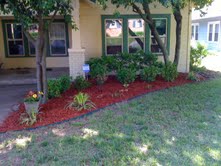
The physical exhaustion is a result of my first major foray into attempting some yard work on my own.  Over the course of three days and used as physical breaks from the grading grind, I raked out our large front bed and pulled weed after weed after weed.  Then, I laid down a ton of new mulch and planted five new plants.  They are hard to see in the picture as they are small yet, but they should fill out the front middle section. 

Both getting my grades turned in and getting this area of the yard in shape come with a great sense of accomplishment, along with some scrapes and bruises and sore muscles.  So, I am content.

I did come to the desk this morning hoping I’d be able to draft something new, and I did get nearly a full page of lines, but I felt like I was pulling every word out of the hard, hard ground, and I’m not happy enough with the result to call it a draft.  After wrestling with it for a half hour or so, I realized that I’m just worn out and need to acknowledge and respect that. 

I’m going to go wild and take today off.  I may sit on the couch and eat bon-bons all day.  I may imitate the cats and take a good, long nap.  Tomorrow, I will read and read and read the mound of poetry waiting for me.  And in this way, I think I’ll be recharged and ready to hit the blank page again.

I definitely need to read through the old manuscript again and see what needs tweaking.  It’s been a finalist and a semi-finalist this year, but so far no joy. 

Oh, and one last major thanks to the poetry universe.  Last year during the Big Poetry Giveaway in April, I was lucky enough to win one or two books.  This year, I hit the MEGA JACKPOT!  I’ve lost track, but I think I won five of the drawings.  Thank you, UNIVERSE!  And thank you to the poets who played along, making my luck possible! 

Posted by Sandy Longhorn
Buy a Book, Help Those in Need

Buy a Book, Help Those in Need

47º~ clear skies, very little wind to speak of, a drying out time

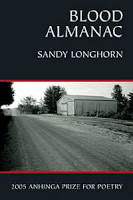
Just a reminder to everyone that while I’m away grading and tying up the ends of the semester, I’m also holding a special promotion.  Buy a copy of Blood Almanac from me directly ($14, email me for mailing address:  sandy dot 40 dot longhorn AT gmail dot com) and I’ll not only donate the entire amount to the American Red Cross, but also, I’ll donate a matching amount of my own money.  It’s a win-win!!!

So far I have two sales, so the counter is up to $56 if I’m doing the math correctly.

Please consider making a purchase to help the victims of our recent storms here in the south or the flooding in other parts of the country.  If you already own a copy (thank you!), consider buying a copy for a friend.

The promotion runs through the end of the day on Saturday, May 7th.

Thinking of everyone trying to recover and piece things back together as the days return to sunshine.

Posted by Sandy Longhorn

Winners!

63deg ~ seriously gloomy skies, all dark outside at nearly noon, on and off rain through Tuesday a.m., flash flood warnings abound

Just a quick post amid the rain and the grading to announce the winners for my part of the Big Poetry Giveaway 2011.

Using a random number generator, the follow names came up:

Stephen S. Mills wins a copy of Blood Almanac.
Colleen O’Neill Conlan wins a copy of Cinema Muto.

Congrats to Stephen and Colleen!  I’ve emailed y’all to ask for your mailing addresses.

If you didn’t win and would still like a copy of Blood Almanac, I hope you’ll consider buying a copy directly from me between now and May the 7th.  As I posted last week, I’m donating 100% of all purchases (plus a matching amount from me) to the Red Cross for tornado and storm relief.  See this post for details.

Stay safe, friends and fans of the Kangaroo.

Posted by Sandy Longhorn
The After-Calm

The After-Calm

50º ~ another beautiful spring day on tap, storms gathering in the west for tomorrow night

I’ll be nose-to-the-grading-grindstone from now until Tuesday, but I leave you with this picture of yesterday’s perfect sky.  Beauty like this is quite painful in the aftermath of the storm and the death toll that keeps mounting.  Still, we all breathe easier under non-stormy skies.

Peace, y’all.

Posted by Sandy Longhorn
A Great Disturbance: Buy a Book, Help Those in Need

A Great Disturbance: Buy a Book, Help Those in Need

46º ~ chilly start to the day, warming up, finally some sun and 24 hours with no predicted severe weather, thank you, universe!

I know this may sound hokey, but when I woke this morning to the news of over 180 people dead from our outbreak of severe weather here in the south and southeast, I couldn’t help but think of Obi-Wan Kenobe: “I felt a great disturbance in the Force.”  I am devastated and sad and mourning.  Especially for the dead and their loved ones, but also for the huge swatch of destruction.  Many people have lost their homes and all of their possessions.  Once again, I feel a bit helpless and hopeless in the face of a natural disaster.

The only good I can do from here is to give money to reputable organizations.  So: I’m offering this deal through May 7.  Buy a copy of Blood Almanac directly from me and 100% of your money will go to the American Red Cross.  While I don’t have a PayPal account in place, I’ll be glad to accept a check in the mail.  To purchase, email me at: sandy dot 40 dot longhorn at gmail dot com.

And to sweeten the pot, I’ll match every purchase with the same amount in a personal contribution.  The cost is $14 (I’ll cover postage).  If you already own a copy, consider buying one for a friend. 

That means, for every purchase, $28 will go to the Red Cross.

As many of you know, tornadoes make frequent appearances in my poems.  Here are two: the first older and in Blood Amanac, the second newer and just published in Escape Into Life.

@font-face {
font-family: “Times”;
}@font-face {
font-family: “Garamond”;
}@font-face {
font-family: “Palatino”;
}p.MsoNormal, li.MsoNormal, div.MsoNormal { margin: 0in 0in 0.0001pt; font-size: 12pt; font-family: “Times New Roman”; }h1 { margin: 0in 0in 0.0001pt; page-break-after: avoid; font-size: 12pt; font-family: “Times New Roman”; }span.Heading1Char { font-family: Garamond; font-weight: bold; }div.Section1 { page: Section1; }

On the Great Plains’ Eastern Edge

People here don’t dream of falling, but the opposite
of falling, the drying up and being blown
across the far-flung horizon during months of drought
when topsoil embeds itself in every surface —
sheets hung on the line to dry, shut eyelids,
hair up in a braid, firmly clamped lips —
when even good roots can’t hold and there’s no water
left in the well to wash it all clean.  Every year
when the twisters come there’s a new story
about your grandmother’s neighbor pulled from sleep
and shaken like a tablecloth before being dropped
in the family plot to rest beside her husband,
dead these twenty years, or the minister and his wife plucked
from the closet where they huddled clutching the Bible
and each other and set down without a scratch
in the yard, not even a ripped page to show for it.
When the rains do come, by God’s own grace
and after a dozen farmers are dead from self-inflicted
gunshot wounds or a noose swung over the hayloft’s beam,
those who remain dream of the swelling up, the washing
away and slow drowning — a different kind of falling.
Our bloated bodies come to rest in the muck
of gray-green lakes.  The silt makes room,
shifts in the gloom and the bluegills come, curious,
the pike, resilient, to nibble at cotton fibers,
spitting out buttons and clasps to get at the heavy, rotting flesh.
(Originally appeared in Hotel Amerika; then Blood Almanac)

Cast out by rough winds and a roar
louder than his father’s voice,
the boy emerged unscarred—
though the frame house shattered
in the hands of a vengeful God.
Orphaned in the aftermath:
the father-body carried off
and buried in a field of debris,
the mother-body, already
a two year absence before the wind,
the boy collected her journals
and stacked them in a leather satchel,
carrying her heavy scrawl
from prairie town to cities on the river.
With one hand on her words, one fist
threatening God, and a voice
packed with his father’s rage,
he could collect the clouds and fling
the funnels far from any home.
(Originally appeared in Escape Into Life)


Be safe, my friends.

Posted by Sandy Longhorn
Sojourner Truth

Sojourner Truth

63º ~ stormy through the noon hour and then we may have a few days peace; friends and fans living east of the kangaroo, keep your heads down, but one eye on the sky

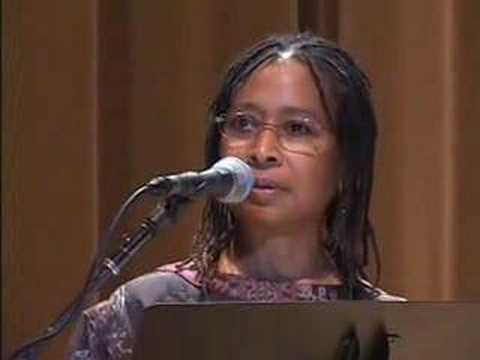
Just a quick video clip this morning to get you pumped up for Wednesday.  Here is Alice Walker channeling Sojourner Truth by reading her famous ‘Ain’t I a Woman?’ from 1851.

Be well, y’all.

Posted by Sandy Longhorn
Free Poetry and a Link to What Editors Want

Free Poetry and a Link to What Editors Want

62º ~ under the threat of tornadoes all day today, batten down the hatches, know the quickest route to your safe place, friends and fans of the Kangaroo

stormy days in Little Rock, River Market District

While I have a brief respite from end-of-the-semester grading, I’m mostly feeling worn down at the edges.  I’m happy that my school work is caught up at the moment, but more papers arrive tomorrow and onward we go into the massive grading that will consume the next two weeks of my life.  In other words, do not be alarmed if I miss a day or two of my normal Monday, Wednesday, Friday blogging. 

For today, remember that there are five days left to enter for a chance to win FREE POETRY: a copy of Blood Almanac OR Jesse Lee Kercheval’s Cinema Muto.  That’s right: two winners!  Click on the link and leave a comment on my previous post and you are entered.  Easy-peasy.  On Sunday, May 1, I’ll use a random number generator to choose the lucky winners. 

~~~~~

Many thanks to Jessica Goodfellow, who blogs at Axis of Abraxas, for the link to this wonderful essay “What Editors Want” by Lynne Barrett, published in The Review ReviewWhile the beginning of the essay focuses on short stories, the subsequent sections are filled with great advice for all writers.  My favorite part is this:

“So your job is to help the editor by sending work that is developed, complete, thoroughly revised, and—of great importance—appropriate for the magazine.

To do that last part of your job well, you have to read the magazines.

Yes, you do.”

I tell my students this over and over, but it’s always good to be able to show them that someone in the industry is saying it too.

It also reminds me that one of my top priorities, post final grading, will be to send out new and appropriate work to my well-research list of journals.  Ah, something to look forward to!

Posted by Sandy Longhorn
Friday Draft:  Record 11 – 4

Friday Draft: Record 11 – 4

67º ~ soggy soupy day, another 20º degree change in highs expected between yesterday and today, forecast full of storms, scattered

Irises on the Hendrix Campus, the antithesis of this week’s poem

Baseball season is fully underway, friends and fans of the Kangaroo, and that means keeping score and keeping track of records.  While the Cubs hover around .500, just breaking even in the wins and losses, I’ve taken stock of my goal to draft a poem a week.  Staring with the first week of January, I’m proud to claim 11 wins and only 4 losses.  Woo Hoo!  My limited math skills say that’s .733 in baseball terms, or 3 and 1/2 games over .500.  (Don’t trust my math!).

Given the craziness of the past week, tornadoes, chalking the walk, the ever-present grading, some drama in the hallway at work, I wasn’t sure what today’s time at the desk would produce.  I did my Thursday night reminder to self about Friday drafting with only half-hearted energy.  As I went through my morning routine today, I tried and tried to think of poetry and was constantly distracted.  Monkey mind, I think, the Buddhists call this when they try to meditate. 

So, I cleared the desk/decks and took down my journal and my folder of poems in progress.  I glanced at the poems from the last few weeks, a new saint and two tales.  I enjoyed returning to the saints last week and thought I might go back there again.  Then, I opened my journal and found this note from last Friday.  “Make the barn poem a haunting tale.”  This will make sense if you stopped by last Friday.  If not, read this.

Just glancing at that scribbled note was enough to set me off and running.  I’m beginning to doubt anyone will want to read a whole book of these tales, but who knows, they seem to be what wants to be written.  I did alter the first line slightly.  Instead of “Once there was a girl…,” this new draft begins, “Once, a girl was born in the shadow / of a well-kept barn.”  The draft is titled “Haunting Tale of Girls and Weathered Barns” so you can probably see that there’s a twist in the poem that takes our girl from this well-kept barn to one that’s falling down a bit. 

Another one of my worries is that these poems do not turn into prose hacked into lines.  I’m desperately focused on the poetic elements as I draft.  Here you might see why I’ve clung to lyric poems for so long and why I’ve shied away from narrative.  I’ll try to focus even more on craft as I revise the poems along the way.

It seems without setting out to do so, I’ve begun writing a series.  Perhaps the form of tales has provided me a way to channel what I want to say about growing up in the Midwest and allows me the freedom of moving past confessional autobiography.  This is all fascinating to me, but I don’t want to think about it too much, lest the poems evaporate.

PS: nothing is evaporating here in real life in the house of the Kangaroo.  There is so much humidity in the air that we are coated in fog this morning and it seeps into the house.  When I printed my drafts, the ink was slightly blurry.  As I looked closer and held the paper near my face, I realized that the paper itself was just a touch damp, soft really.  When I lived in the Midwest, I thought I knew humidity; NOPE, the South wins on that!

Posted by Sandy Longhorn