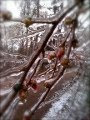
28º and the solid, snow-white sky mirrors the solid, snow-covered ground; no melting
On Monday, we received 5 inches of snow followed by 2 inches of freezing rain followed by another inch and a half of snow. The rain did melt down the snow blanket some, but the snow following built it back. There was no wind at all. So, we had a perfectly even coating, save where the trees caught some of the snow on the way down. Yesterday, there was sun, but the temp only reached 35º for a few hours late in the day, so little melting occurred. I can’t remember snow lingering like this during the 5 years I’ve lived in Little Rock. I find that school closings and the weather condition has slowed me to a sluggish pace.
But on to the links.
Rarely do I fall in love with poems on both Verse Daily and Poetry Daily on the same day, but today I did. Check out Lucia Perillo’s wonderful poem “The Wolves of Illinois” on Poetry Daily today for a foray into the power of certain namings. Also, check out Peter Richardson’s “A Mid-Wife’s Late Sabbatical” on Verse Daily. The formatting of the poem struck me first. How did he achieve that wonderful inward bowing of the line breaks? Of course, formatting doesn’t make a poem, and I was glad to find I enjoyed the content of the poem just as much. Some great images and sounds in there.
~~~~~
Martha Silano blogs at Blue Positive and has a great post up about the value of editors and rejections.
~~~~~
Stephen Mills, blogging over at Joe’s Jacket, has a fine post about the non-ending debate over the worth of an MFA/PhD. I concur with almost all Mills says and think I’ll stop reading any more articles/blogs about the whole subject.
~~~~~
On a non-poetry note, thanks to The Rumpus for this link to a great set of pictures of some baby pandas. Sometimes you just need some baby panda love. What I love about the group shot (16 baby pandas held by 16 men) is the wide variety of expressions and postures. I could look at this for hours.
~~~~~
Yesterday, I spent part of my snow day working on this year’s NEA grant application. This will be my third submission for an NEA. The application comes around every two years, and every two years, I go through the same set of emotions. I begin with cautious optimism. Then I open the application forms and my heart rate increases alongside my blood pressure. I feel stressed. Why? Partially, I believe, because of the forms that are so governmental; my body goes through the same physical changes when I open TurboTax each February/March (why must the NEA be at the same time?). In any case, the NEA forms and directions are filled with warnings about following the directions precisely. I get so caught up in filling in the blanks exactly that when it comes time to pick the poems, my mind is a mess. (This is definitely a multi-day process in order to get some clarity.)
From another point of view, the stress lessens after I remember all the things I learned two years ago. Yesterday, it took me an hour (an hour!) to remember that I had saved all the documents on my computer from 2008. Of course I needed a new manuscript this year, but I could at least use the ’08 docs as a guide. That helped immensely. I felt like I was having to relearn a foreign language every few years. Perhaps I’ll remember sooner in 2012.
As for the stress of picking the poems, here is where I hesitate. How do you, Dear Reader, select 10 pages of your own poetry? Obviously, we want those 10 pages to be our best, but how to decide on “best”? Do you only select poems that have been published in lit mags or in your book if you have one? Do you only select poems written most recently (as indicative of your current project)? In 2006, I included 10 poems from Blood Almanac. In 2008, I included 3 of those poems and 7 new ones from my new manuscript. This year, I have 1 poem that overlaps with 2008, but the rest are new. All 10 have been published, and this year I also paid attention to the arc of the manuscript, a mini-chapbook, if you will. Is that a good strategy?
What I do know is that I will send the application off this weekend, having returned to cautious optimism. Then, because the announcement of results does not arrive until November/December, I will forget about the fellowship on most days. On days when I do think of it, I will remember that the odds of winning are like the lottery. There are hundreds of applications and a relative handful of winners. Judging poetry is subjective. There’s always 2012.